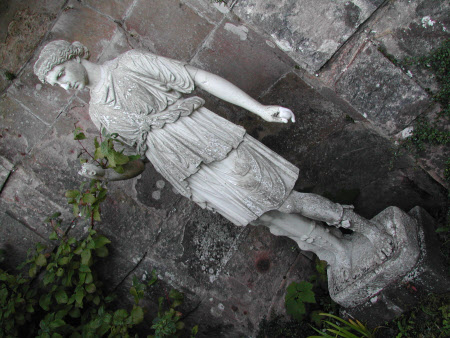
Diana statue

Category
Art / Sculpture
Date
1 AD - 200 AD - 1778
Materials
Stone
Measurements
1540 mm (H)510 mm (W)330 mm (D)
Order this imageCollection
Downhill, County Londonderry
NT 180510
Summary
Under life-size marble statue of Diana, virgin goddess of the hunt. Roman head (first to second century AD) with probable neo-classical body (1778). The head is crowned, with the hair centrally parted and pulled back to a bun at the back of the head, creating a voluminous frame around the brow. The face is based on models of the fourth century BC. Diana wears a sleeveless chiton, fastened on the left shoulder, over a sleeved tunic.
Full description
Superficially, this statue of the Roman goddess Diana conforms to a typical classical iconography. Wearing boots and a short chiton, her right hand reaches upwards to pluck an arrow from a vanished quiver at her shoulder, while her left hand holds all that remains of her bow, the grip. However, while the head appears to be the work of a classical sculptor, inconsistencies and anomalies in Diana’s garments, alongside the rustic detailing of the plinth, suggest the body may in fact be an eighteenth-century creation. In 1778, the art dealer Gavin Hamilton sent avid collector Charles Townley a sketch of the head of a statue of Diana, as a sort of mail order proposition. Discovered during Hamilton’s excavations at the Roman baths at Gabii, 18km east of Rome, it may well be the head of this statue. In response to Townley’s further enquiries, Hamilton wrote in December 1778 that he had already sold the statue of Diana to Frederick Hervey, Bishop of Derry. Hervey was on his third tour of Italy with his family at the time, establishing himself as a major collector and patron of the arts. Hamilton describes the statue in his letter to Townley as if it were an entirely classical work – he mentions, for example, the hole for the rivet which would have fixed the quiver to Diana’s shoulder. Both Townley and Hervey would have expected some restoration work to have been undertaken, but it is possible that very much more of this statue was a reconstruction than either was aware. The Bishop bought Diana for the house he was building at Downhill, County Londonderry. She was displayed in a niche in the spinal corridor of the principal floor, alongside sculptures of other deities and mythological characters including Flora, Minerva, Leda, Venus and Apollo. This statue is one of very few to have survived intact following a disastrous fire at Downhill in 1851, in which many of Frederick Hervey’s artworks were destroyed.
Provenance
Head by an unknown Roman sculptor, first to second century AD; excavated by Gavin Hamilton 1778, possibly from Roman baths at the site of Gabii; body probably by an unknown sculptor, 1778; purchased by Frederick Augustus Hervey, 1778; bequeathed to Rev. Sir Henry Bruce; by descent to Sir Henry Hervey Bruce; purchased by the National Trust with assistance from the Ulster Land Fund, 1962.