Nutmeg grater
Category
Silver
Date
circa 1695
Materials
Silver
Measurements
1.9 x 12.7 x 3.2 cm
Order this imageCollection
Ickworth, Suffolk
NT 852795
Summary
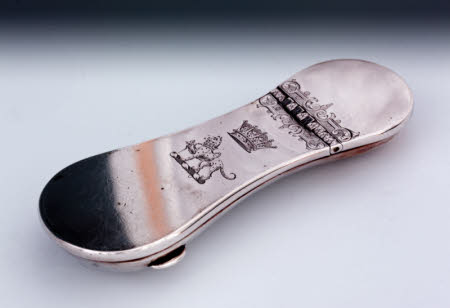
Silver nutmeg grater, circa 1695. The raised, bow shaped base is of semi-circular section and is divided internally into two uneven compartments both of which are gilded, the larger having a roughly perforated silver (?) grating plate. A silver divider between the compartments, soldered in place, has a semi-circular opening at the base. The flat lids with raised, right-angled lips open from a shared nine-part pinned hinge, with bands of baroque engraving to either side. Two lugs of silver are soldered at the wider end as finger holds. Heraldry: The larger of the lids has been re-engraved later, probably c. 1751, with the Hervey crest and an earl’s coronet.
Full description
Double compartmented boxes of this period with graters are exceptionally rare survivors and are thought to have been intended either for nutmeg or for snuff, the latter commonly being provided in a solid form as well as ready powdered in the late 17th and early 18th centuries.[1] The 1811 plate list prepared for the 5th Earl (subsequently 1st Marquess) of Bristol specifies that this and the other grater in the collection (852796) were then for nutmeg, which was at the height of its popularity as part of the late Georgian craze for toddy-drinking.[2] By then too, personal snuff grating appears to have completely ceased, certainly amongst the wealthy classes.[3] There are, however, no references to nutmeg boxes or graters in the 1st Earl’s accounts whereas both he and Lady Bristol, plus their children once in adulthood, were enthusiastic consumers of snuff. Further support for snuff is given in the case of this grater by its large size (unusual for nutmeg graters), its gilded interior (common in snuff boxes) and by a comparably shaped and dated grater in the Victoria and Albert Museum which is considered to have been for snuff.[4] Other snuff graters of a similarly elongated form are also to be found in ivory and boxwood, again well demonstrated by examples in the V & A.[5] A conveniently sized block of solid tobacco would be grated to produce powdered snuff which could pass from the large to the small compartment and from there be dispensed. The small compartment also acted as a store for the block of tobacco which, in that form, would retain freshness and flavour. Although snuff taking may have been introduced to the French court as early as the late 16th century, Catherine de Medici supposedly using it as a cure for persistent headaches, the habit took hold under Louis XIV in spite of that monarch’s disapproval. From France it spread to England at the Restoration and was widespread amongst the aristocracy by the last decade of the 17th century.[6] Early boxes of a small size are hard to date because of their lack of hallmarks, at most having a maker’s marks and in this case lacking even that. The style of the engraving around the hinge on this example, however, suggests that it was made in the very late 17th century or early 18th century and it could be the silver snuff box for which John Hervey (the future 1st Earl) paid £1 10s on the 30th January, 1690. The sum is about right for the weight and intricate workmanship required for such a precisely engineered object. Furthermore, graters and snuff boxes were carried about as a pair by partakers at this time and a few days earlier, on the 24th January, Hervey recorded that he ‘Paid then for a Gold Snuff box, which be it here remembered, ye Goldsmith Mr Howerd of whom I bought it, is obliged whenever I return it, to allow me for it again six pounds, & a Crown’ (5 shillings less than Hervey paid). Sadly no early gold snuff boxes survive at Ickworth. Hervey went on to buy another silver snuff box, along with other items, in 1695, from Charles Mather ‘ye Cane-man in ffleet Street’, perhaps for his second wife, Elizabeth Felton, who he married that year. In 1713 she was the recipient of a gold snuff box from her husband, bought for £20, and he acquired two more, for himself and his eldest son, Carr Hervey, in 1714, for £22 6s and £19 14s 6d respectively. Finally, on the 21st October 1726, what must have been a silver snuff box was purchased for £1 10s and given to a Mrs Saint Hayes.[7] James Rothwell, Decorative Arts Curator March 2020[Adapted from James Rothwell, Silver for Entertaining: The Ickworth Collection, London 2017, cat. 2, pp. 67-8.] Notes: [1] Ian Pickford, Antique Silver, Woodbridge 1998, p. 134. [2] G. B. Hughes, Small Antique Silverware, New York 1957, p. 58. [3] Edinburgh Review or Critical Journal for January …. May 1828, p. 500. The text suggests that snuff graters had been almost entirely forgotten about by 1828. [4] V & A museum number 1348-1902. There are also ivory and boxwood examples in the V & A collection. For a further example of a bow-shaped silver grater, then thought to be for nutmeg, see Smith 1907, p. 173, plate H.[5] For instance V & A museum nos. CIRC. 489-1923 and 1417-1902.[6] For a detailed analysis of the history of snuff taking see E. R. Billings, Tobacco: Its History, Varieties, Culture ..., Hartford 1875, pp. 218-258. An illustration of a two-compartmented grater is given on page 220.[7] See James Rothwell, Silver for Entertaining ..., London 2017, appendix 1.
Provenance
John Hervey (subsequently Lord Hervey and 1st Earl of Bristol; by descent to the 4th Marquess of Bristol; acquired by the National Trust in 1956 under the auspices of the National Land Fund, later the National Heritage Memorial Fund.
Credit line
Ickworth, the Bristol collection (National Trust)
Marks and inscriptions
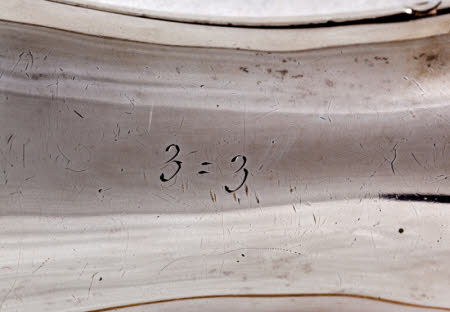
Underside: Scratchweight: '3 [tr. oz] = 3 [dwt]'