Mortar
Spanish School
Category
Art / Sculpture
Date
1550 - 1700
Materials
Bronze
Measurements
82 mm (Height); 129.5 mm (Diameter); 99 mm (Diameter)
Place of origin
Spain
Order this imageCollection
Anglesey Abbey, Cambridgeshire
NT 514979
Summary
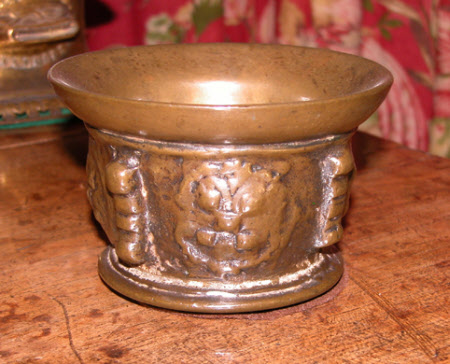
Bronze, mortar, Spanish School, 1550-1700. A small Spanish mortar, with squat conical body, a flared rim and a moulded foot. The body decorated with four segmented ribs, between which are four probably pseudo-heraldic shields. The design of these is not very clear, but appears to consist of five joined rectangular shapes within a foliate cross.
Full description
Various forms of stones and dishes have been employed for the grinding or pounding of foodstuffs, minerals and pharmaceutical materials since the Neolithic period or even before. Grinding bowls are first recorded as early as 9,000 B.C and recognisable mortars and pestles, the hand-held tool used to do the actual grinding, were made by the Greeks and the Romans. Although bronze mortars were made in antiquity, they began to made in larger numbers from the medieval period onwards, with shapes evolving over the centuries (for an introduction to mortars, see Peta Motture, Bells and Mortars. Catalogue of Italian Bronzes in the Victoria & Albert Museum, London 2001, pp. 13-50). This modest mortar is one of a group of three similar examples at Anglesey Abbey, which may have been acquired as a group by Lord Fairhaven at some date between 1932 and 1940 (for the others, see NT 514971 and 514978). They are described in the 1940 inventory as in the Living Room, where they served as ashtrays. Two are certainly and the third probably Spanish, so perhaps they were acquired together on a visit to that country. The mortar is of a type that developed in Spain in the sixteenth century (For the type, and Spanish Renaissance mortars more generally, see Museo Retrospectivo de Farmacia y Medicina de los Laboratorios del Norte de España, S.A., Masnou 1952, pp. 16-30; Edmund Launert, Der Mörser. Geschichte und Erscheinungsbild eines Apothekengerätes, Munich 1990, pp. 64-65, 178-81, figs. 186- 93). These mortars are squat in form and broader than they are high, with the body almost always divided with some form of vertical ribbing. They have a spreading lip and often a projecting foot, but only very rarely do they have handles. The body is generally decorated with applied elements between the ribs, such as eight-pointed stars, cockle shells (the symbol worn by pilgrims to Santiago de Compostela), coats-of-arms, plant motifs and masks. A mortar of the general type may be seen in the lower right corner of Diego Velázquez’s Kitchen Scene of 1618-20, in the Art Institute of Chicago. None of this class of Spanish mortars is dated or signed, making their dating extremely difficult. They seem to have been produced from the early sixteenth into the eighteenth centuries. An identical mortar was in the collection of the Laboratorios del Norte (Museo Retrospectivo de Farmacia y Medicina, fig. 49).Jeremy Warren2019
Provenance
Acquired by Urban Huttleston Rogers Broughton, 1st Lord Fairhaven (1896-1966) with two other similar mortars between 1932 and 1940; listed in the Anglesey Abbey inventory of 1940, p. 21, Living Room, valued at £15 the three mortars; bequeathed to the National Trust by Huttleston Rogers Broughton, 1st Lord Fairhaven (1896-1966) with the house and the rest of the contents.
Credit line
National Trust Collections (Anglesey Abbey, The Fairhaven Collection)
Makers and roles
Spanish School, sculptor
References
'Anglesey Abbey, Lode, Cambridgeshire. An Inventory and Valuation of Furniture, Books, Ornamental Items & Household Effects .. prepared for Insurance Purposes’, Turner, Lord and Ransom, April 1940, p. 21. Christie, Manson & Woods 1971: The National Trust, Anglesey Abbey, Cambridge. Inventory: Furniture, Textiles, Porcelain, Bronzes, Sculpture and Garden Ornaments’, 1971, p. 143.