Sir William Brownlow, 4th Bt Brownlow of Humby MP (1665-1702)
John Riley (London 1646 – London 1691) and John Closterman (Osnabrück 1660 – London 1711)
Category
Art / Oil paintings
Date
circa 1685 - 1688
Materials
Oil on canvas
Measurements
2235 x 1245 mm (88 x 49 in)
Order this imageCollection
Belton House, Lincolnshire
NT 436004.1
Caption
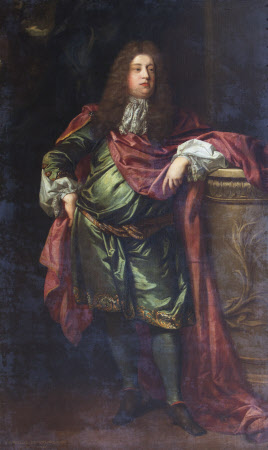
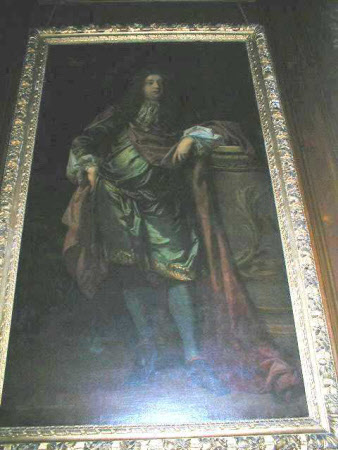
This painting is one of the four 'verie large Pictures' that seem to have been in the Saloon at Belton since 1688. When Riley painted these pictures, he appears to have had the assistance of the recently-arrived John Closterman. He reputedly got £40 a full-length, painting only the heads himself, and giving Closterman just 30s (£1.50) for all the drapery Sir William was the son of Sir Richard Brownlow (1628-68) and Elizabeth Freke (1634-84). He married twice: firstly, Dorothy Mason (?1655-1699/1700); and secondly, Henrietta Brett (1681-1718). He inherited Belton after the death of his elder brother, 'Young' Sir John, in 1697, but never lived here himself. He was the father of Viscount Tyrconnel and of Anne Brownlow, who brought Belton into the Cust family.
Summary
Oil painting on canvas, Sir William Brownlow, 4th Baronet Brownlow of Humby, MP (1665 - 1701) by John Riley (London 1646 - London 1691) and John Closterman (Osnabrück 1660 - London 1711), circa 1685/88. A full-length portrait of the son of Sir Richard Brownlow, 2nd Baronet (1628 - 1668) and Elizabeth Freke (1634 - 1684) as a plump young man, standing, leaning on a pedestal with his left arm, turned slightly to the right, wearing a green robe over a white shirt, green stockings and a red cloak which he has looped up and holds on his hip with his right hand, a white lace cravat and a long flowing wig. When Riley painted the four pictures at Belton (NT 436004.1-2 and 436005.1-2), he appears to have had the assistance of the recently-arrived John Closterman, and reputedly got £40 a full length, painting only the heads himself and giving Closterman just 30s (£1.50) for all the drapery. William married, firstly, Dorothy Mason (1664 - c.1700), daughter of Sir Richard Mason and Anne Margaret Long and secondly Henrietta Brett (1681 - 1718). He was MP for Peterborough between 1689 and 1698, and Bshop's Castle between 1698 and 1700. He succeeded to the title of 4th Baronet Brownlow of Humby on 16 July 1697. He inherited Belton after the death of his elder brother, 'Young' Sir John, in 1697, but never lived here himself. Sir William's home was at Humby. The children of Sir William Brownlow, 4th Bt and Dorothy Mason were: Anne Brownlow (1685 - 1779) married Sir Richard Cust (1680 - 1734), 2nd Baronet of Pinchbeck; Richard Brownlow (1689 - 1690); John Brownlow, 1st and last Viscount Tyrconnel (1690 - 1754); Dorothy Brownlow (b.1695) and William Brownlow (1699 - 1726).
Provenance
Listed in the inventory of 1688; purchased with a grant from the National Heritage Memorial Fund (NHMF) from Edward John Peregrine Cust, 7th Baron Brownlow, C. St J. (b.1936) in 1984
Credit line
Belton House, The Brownlow Collection (acquired with the help of the National Heritage Memorial Fund by the National Trust in 1984)
Marks and inscriptions
Recto: Inscribed bottom left: SIR WILLIAM BROWNLOWE BART PAINTED BY RILEY
Makers and roles
John Riley (London 1646 – London 1691) and John Closterman (Osnabrück 1660 – London 1711) , publisher