The Infant Bacchus Riding on a Goat
possibly London
Category
Tapestries
Date
circa 1670 - circa 1690
Materials
Tapestry, wool and silk, 6 warps per cm
Measurements
2090 x 1850 mm
Order this imageCollection
Cotehele, Cornwall
NT 348253.3
Summary
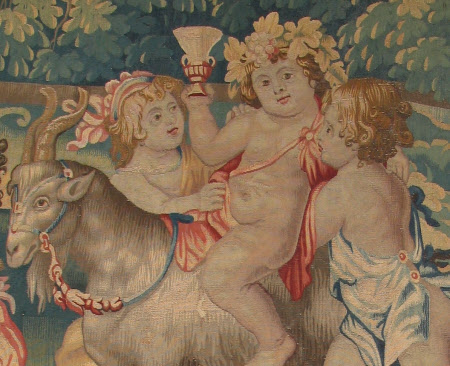
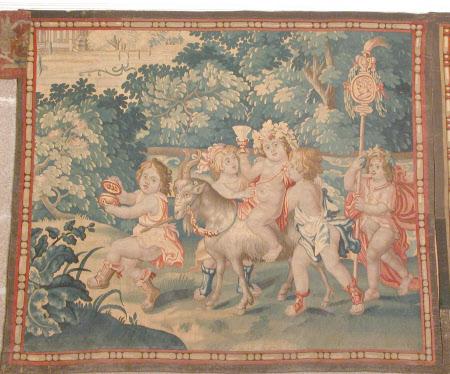
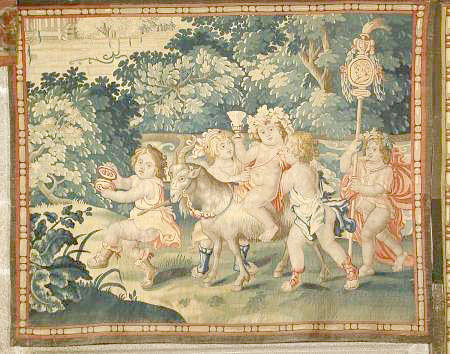
Tapestry, wool and silk, 6 warps per cm, The Infant Bacchus Riding on a Goat from a set of seven Bacchanals, Antwerp or London, c. 1670-1690. The infant Bacchus, naked save for a red cloak tied over his shoulder and a wreath of vine leaves twined around his head, slumps drunkenly on the back of a goat, looking out at the viewer and holding aloft a wine glass. He is supported on either side by two companions wearing sandals and scanty drapes. The procession is headed by a boy dancing and playing cymbals with a pipe tucked into his waistband, and bringing up the rear is a boy wearing a short shirt, a billowing red cloak and vines in his hair and carrying on a pole a golden medallion portrait of a grinning God, probably Bacchus, the pole wreathed in laurel and with a torch burning on top. The narrow bead-and-reel border is in numerous different sections and has been sewn on all four sides.
Full description
This tapestry forms the thematic centrepiece of the Cotehele ‘Bacchanals’, representing the infant Bacchus himself. The form of the procession draws on both the images of religious processions found on Roman sarcophagi, and on the many representations of such subject matter created in the sixteenth and seventeenth centuries; but whilst Bacchus and his followers are usually adult, here as elsewhere in the tapestry series they are infants. The tapestry may originally have been part of a larger piece along with ‘Boys Climbing a Tree’ (348253.2) and ‘Boy Satyrs Dancing’ (348253.6), which appear together in other known examples. The playful and drunken children that populate the Cotehele ‘Bacchanals’ are devotees of Bacchus, popularly the god of Wine, but originally a god of fertility who was worshipped in the form of a bull or goat (hence the frequent appearance of goats in the tapestries), and whose rites were accompanied by frenzied orgies. Many of the scenes in the Cotehele tapestries reflect traditional imagery of Bacchanalian revels, which often include processions of dancers drinking and beating tambourines. Bacchus is also often accompanied by satyrs, creatures with goats’ legs, bearded faces and horns, who were variously personifications of evil (and in particular of lust), and fertility spirits, hence the child satyrs that appear drinking and dancing in the tapestries. The remains of at least two different weavings of the ‘Bacchanals’ can be distinguished in the Punch Room at Cotehele, one in a narrow bead-and-reel border and the other in a wider border with acanthus leaves on a blue ground. One of the acanthus-leaf borders still bears its original galloon, woven with a mark in the form of a red cross on a white shield. This mark was first used at the Mortlake tapestry manufactory on the outskirts of London in the 1620s, and in the late seventeenth century it was adopted by other workshops operating in and around London; it is very probable therefore that at least one of the sets of ‘Bacchanals’ at Cotehele is English. Although the two different sets of ‘Bacchanals’ in the Punch Room at Cotehele are very close in style, a related tapestry hanging in the White Room (348253.7) has a slightly different character and may come from a different set again, which could be either English or Flemish. The first record of ‘Bacchanals’ being woven in England appears in the accounts of the Lord Chamberlain in 1668, when the Royal Arras Worker Francis Poyntz was paid the large sum of £497 5s 0d “For one Riche Suite of hangings called The Bacchinalls […] being the first made after the Designe” (Thomson 1973, p. 355). Later inventories suggest that Poyntz supplied at least two sets of ‘Bacchanals’ to the crown (ibid. pp. 364, 368), and he was almost certainly responsible for a set of ‘Bacchanals’ recorded in the 1675 inventory of the Duke of Ormond at Dunmore, an inventory which included a number of other tapestry subjects that Poyntz is known to have produced (ibid., p. 355). Two 'Bacchanal' tapestries with the signature of Thomas Poyntz, who took over some of Francis’s cartoons on his death in 1684, were with the London dealer E H Benjamin in 1934 (Göbel 1934, vol. II, figs. 147a, b; Hefford 2010, p. 252). At Boughton House there is a set of ‘Bacchanals’ which repeats the designs of most of the Cotehele panels but in reverse; these have a border with a spotted snake, which appears elsewhere on tapestries signed by Francis Poyntz (Hefford 1992, p. 106). Two panels with simplified versions of the designs seen at Cotehele, and in very similar acanthus leaf borders but with a brown ground instead of blue, bear the signature of Thomas Poyntz and thus provide further evidence of the English origin of the set (sold Christie’s London 27 March 1930, lot 148). A set now in the Toms Collection, Lausanne, was almost certainly supplied in London in 1700 by the Huguenot Leonard Chabeneix, but it is not clear whether he was responsible for producing the set or simply a dealer (Hefford 2010, pp. 252-3). Similar tapestries are also known to have been woven in Antwerp in the late seventeenth century, and Wendy Hefford has speculated that some of the known weavings of the ‘Bacchanals’, such as the set at Boughton House, may in fact be Flemish (Hefford 1992, p. 106; Hefford 2010, pp. 251-3). The ‘Bacchanals’ have not always hung in the Punch Room. Nicholas Condy’s view of the Red Room in c. 1840 shows ‘The Infant Bacchus on a Goat’ (348253.3) hanging over the fireplace, and the Rev. Arundell’s accompanying description of the room describes this tapestry simply as ‘Bacchanals’, and mentions a further tapestry of a ‘Vintage’ upstairs in Queen Anne’s Room. Arundell records another ‘Vintage’ in the White Room, probably ‘Boys pouring Wine’ (348253.7) which still hangs there today. (Helen Wyld, 2010)
Provenance
First recorded at Cotehele c. 1840; left at Cotehele when the property was accepted in lieu of tax from Kenelm, 6th Earl of Mount Edgcumbe (1873-1965) and transferred to the National Trust in 1947; amongst the contents accepted in lieu of estate duty by H M treasury and transferred to the National Trust in 1974.
Credit line
Cotehele House, The Edgcumbe Collection (The National Trust)
Makers and roles
possibly London, workshop possibly Antwerp , workshop
References
Hefford, 2010: Wendy Hefford, ‘The English Tapestries’, in Guy Delmarcel, Nicole de Reyniès and Wendy Hefford, The Toms Collection Tapestries of the Sixteenth to Nineteenth Centuries, Zürich 2010, pp. 239-294 Hefford, 1992: Wendy Hefford, 'Ralph Montagu's Tapestries', in Tessa Murdoch (ed.), Boughton House, the English Versailles, London 1992 Hefford, 1991: Wendy Hefford, The Cotehele Tapestries, The National Trust, 1991 (n.p.) Hefford, 1988: Wendy Hefford, 'Introducing James Bridges: new light on an English series of Eucharist tapestries.' Arts in Virginia, vol. 28 (1988), 34-47 Forti-Grazzini, 1994: Nello Forti-Grazzini, Gli Arazzi (Il patrimonio artistico del Quirinale), 2 vols., Rome 1994 Thomson, 1973: W G Thomson, A History of Tapestry from the Earliest Times until the Present Day, 3rd edition, Wakefield 1973 Marillier, 1930: Henry C Marillier, English Tapestries of the Eighteenth Century, London 1930 Arundell, 1840: The Rev. F V J Arundell (illustrated by Nicholas Condy), Cothele, on the banks of the Tamar, London c. 1840