Grotesque
Roy Coles

Category
Tapestries
Date
circa 1650 - circa 1700
Materials
Tapestry, wool and silk
Measurements
3.00 m (H); 2.18 m (W)
Place of origin
Unknown
Order this imageCollection
Knole, Kent
NT 130111.4
Summary
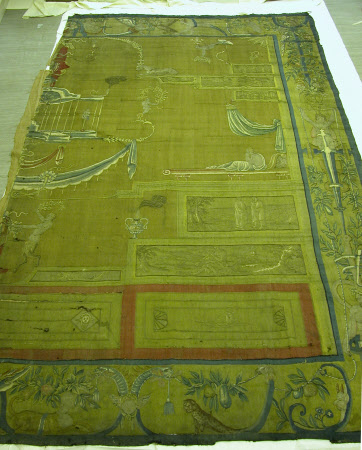
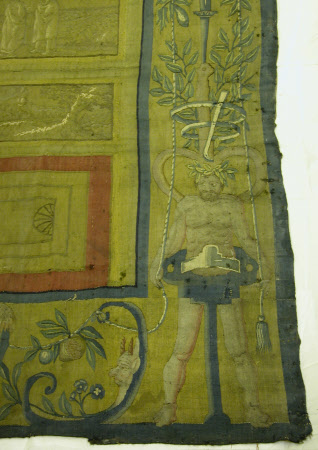
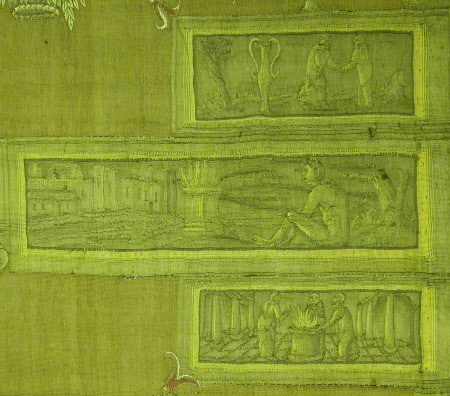
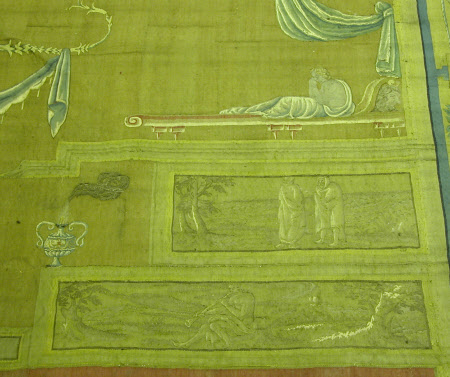
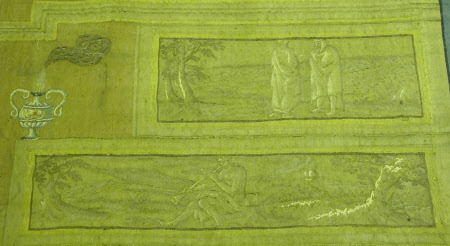
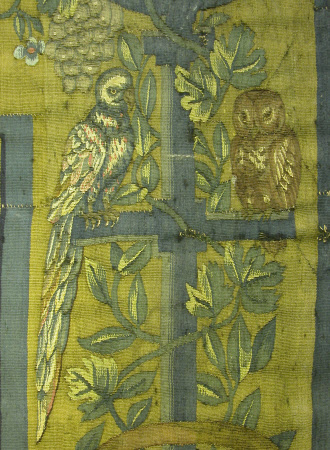
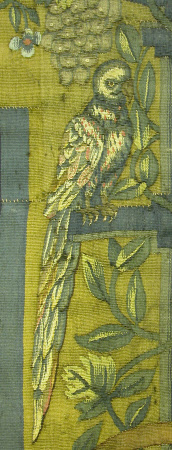
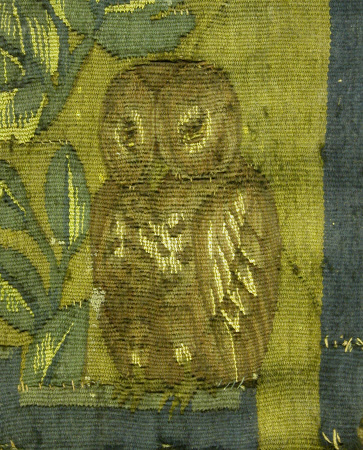
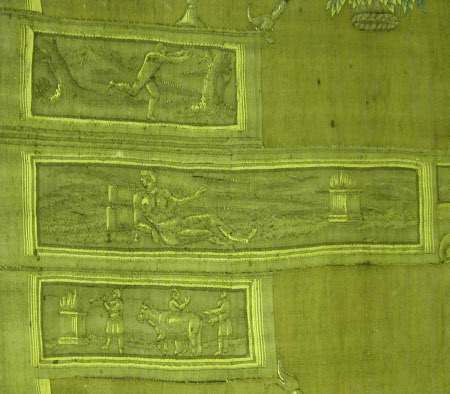
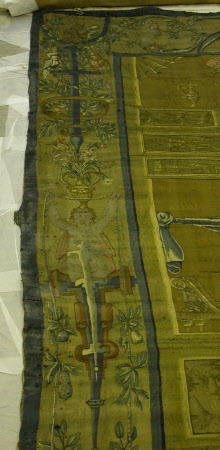
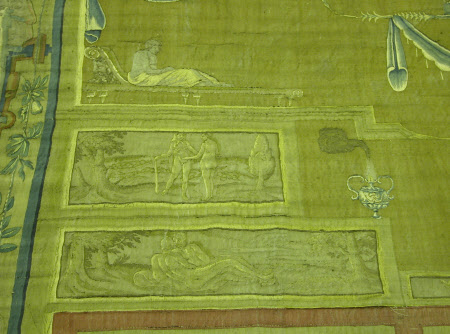
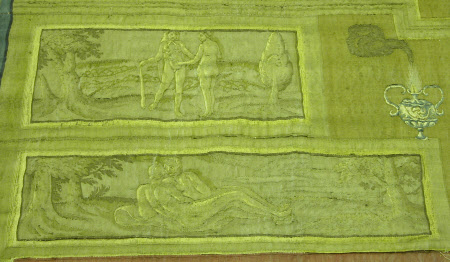
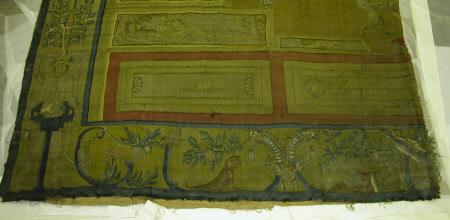
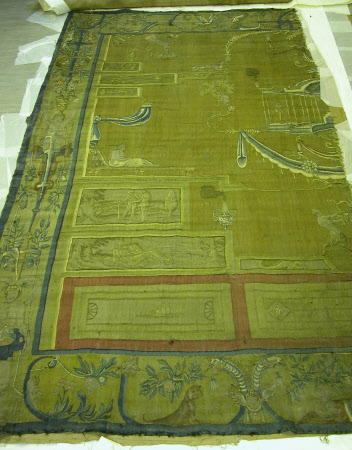
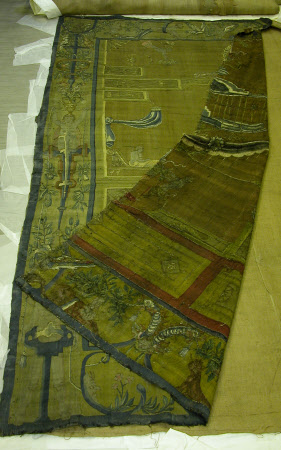
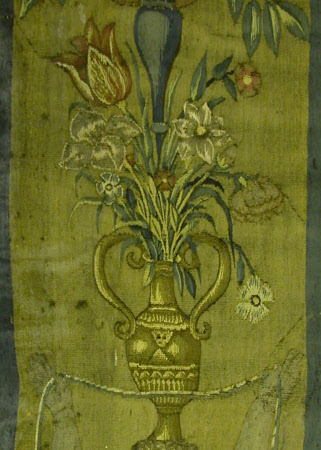
Tapestry, wool and silk, Grotesque (fragment), from a set of four similar fragments, unknown manufacture, c. 1660-1700. The right half of a tapestry with a design of grotesque work on a brownish yellow ground. To the left, cut in half, is a cage suspended from the top of the tapestry with a blue lobed ribbon hanging beneath it. At the bottom left is a satyr. At the lower right are three marble steps, decorated with reliefs of figures and supporting a smoking urn and a small figure reclining on a low couch. Below this are marble panels with a red outline and further patterned reliefs. At the upper right similar marble steps extend from the edge supporting fanciful zoomorphic decorations. At the top, bottom and right hand side there are borders decorated with strapwork, figures, animals and foliage, and a blue galloon runs around the outside of the border. The tapestry has been cut on the left. It was probably once part of the same piece as 130111.3, which has an identical design but in reverse.
Full description
The four tapestry fragments in storage at Knole seem to be part of two complete tapestries, and were once part of a larger set. Similar fragments survive at Knole but have been used to make loose covers for some chairs in the house (see for example nos. 12591.1, 2, 3), and there is also a complete tapestry owned by the Sackville family. Tapestries with Grotesque designs became popular following a series of ‘Grotesque Gods’ designed by Raphael’s workshop and woven for Pope Leo X in the 1520s, and similar designs were produced by a number of European workshops during the sixteenth and seventeenth centuries. On stylistic grounds the tapestries at Knole can be dated to the second half of the seventeenth century. A comparable set of grotesques with a red ground was produced by Michiel Wauters in Antwerp in the 1670s and 1680s (Delmarcel 1999, p. 257). The attribution of the Knole tapestries however poses something of a puzzle. The only complete tapestry in the set, which is privately owned, bears two otherwise unknown makers’ marks. The first is a greyish shield (the colour may have faded), whose right half is sadly missing, with what appear to be two golden crowns arranged one above the other in the centre and two gold flecks below them. The second is a monogram combining the letters M, L and C. According to the convention set by the Netherlandish centres in the early sixteenth century and followed widely in the rest of Europe, the shield should denote the place of manufacture and the monogram the owner or master of the workshop, however it has not been possible to match the shield or the monogram to any known maker or production centre. The early provenance of the tapestries is unknown and they cannot be positively identified in any of the seventeenth or eighteenth century inventories of Knole. (Helen Wyld, 2013)
Credit line
Knole, The Sackville Collection (The National Trust)
Makers and roles
Roy Coles, workshop
References
Delmarcel, 1999: Guy Delmarcel, Flemish Tapestry, Tielt 1999