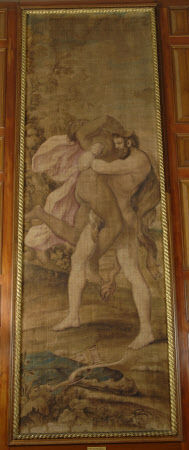
Hercules and Antaeus
attributed to Giovanni Maria Bottalla (Savona 1613 - Milan 1644)
Category
Art / Oil paintings
Date
1630 - 1669
Materials
Distemper on herringbone canvas
Measurements
3658 x 724 mm (144 x 28 1/2 in)
Place of origin
Bologna
Order this imageCollection
Kingston Lacy Estate, Dorset
NT 1257080.2
Caption
Hercules wrestles with the giant Antaeus, whose strength was derived from touching earth. Hercules’ bow and quiver lie on the ground. He lifts his swarthy opponent up thus weakening him and kills him by crushing him with his arms. This is not one of the Twelve Labours of Hercules but additional victorious feat. Bottalla studied painting in Rome and one of his patrons there gave him the flattering nickname of il Raffaellino (little Raphael). He moved to Genoa in the early 1640s and began work on monochrome frescoes in the Palazzo Ayrolo Negrone but died before finishing them. According to records, this series, painted in oil and distemper, known in Genoa as succhi d’erbe (juices of plants) in order to look like a tapestry, was bought for Kingston Lacy from a Palazzo Cambiaso in Genoa by William Bankes (1786–1855) as by Annibale Carracci, and he regarded them as his finest acquisitions.
Summary
Distemper painting on herringbone canvas, Hercules and Antaeus attributed to Giovanni Maria Bottalla (il Raffaellino) (Savona 1613 - Milan 1644), mid-17th century. Hercules, his bow and quiver cast aside, raises Antaeus off his mother earth, thus depriving him of his power. Not one of the Twelve Labours of Hercules, but an additional feat, in which he wrestled the giant Antaeus, who was invincible so long as he maintained contact with earth.
Provenance
acquired by William John Bankes (1786-1855), before 1844, from the Palazzo Cambiaso, Genoa; bequeathed by (Henry John) Ralph Bankes (1902 – 1981) to the National Trust, together with the estates of Corfe Castle and Kingston Lacy and its entire contents in 1981
Marks and inscriptions
HERCULES AND ANTAEUS / ANNIBALE CARRACCI (painted in black on fixed gilt label, on wall below the hanging)
Makers and roles
attributed to Giovanni Maria Bottalla (Savona 1613 - Milan 1644), artist Italian (Bolognese) School, artist Annibale Carracci (Bologna 1560 - Rome 1609), artist