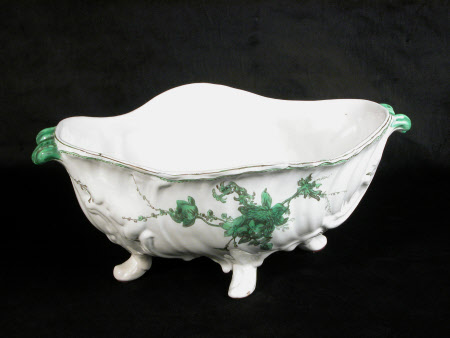
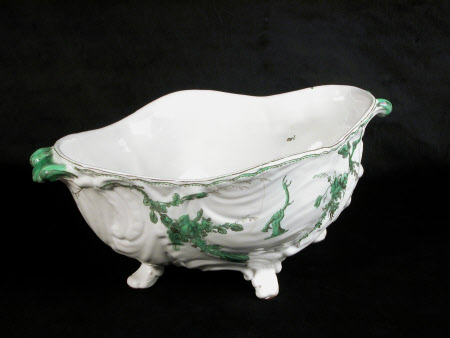
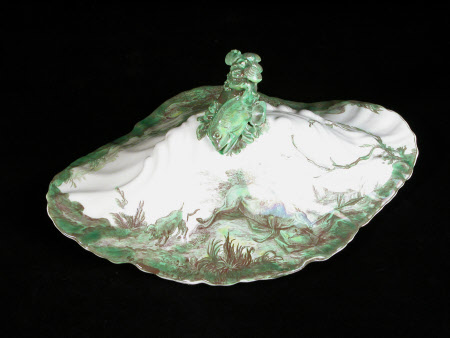
Tureen and cover
Gaspard Robert Factory

Category
Ceramics
Date
1765 - 1775
Materials
Faience
Measurements
295 x 275 mm; 390 mm (Length)
Order this imageCollection
Saltram, Devon
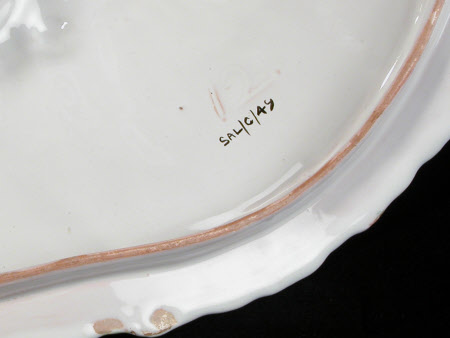
NT 870803.5
Summary
A pair of tureens and covers, tin glazed earthenware (faience), asymmetric form with lobed, slightly out-turned rim, standing on four short curved feet, two rocaille moulded ledge handles, the domed cover of a corresponding asymmetric form with slightly upturned rim, the finial in the form of a fish and clams, Gaspard Robert factory, Marseilles, 1765-1775; the body and cover with sweeping rococo mouldings, painted in green and black with a spreading arrangement of flowers to one side, the armorial crest of the Parker family, comprising an upright arm holding a stag antler to the other side, between sprays of flowers, the rim and handles in green, the cover painted at the edge with a landscape scene including a deer lying next to hunting trophies, a wild pig to its left, the knop and rim in green.
Full description
This part dinner and dessert service is made from a type of ceramic usually called faience in France – a speciality of the factory of Gaspard Robert in Marseilles. Each pot was covered in a white tin glaze, which provided the perfect canvas for the vivid green painted decoration, which includes the Parker family armorial crest. The service is covered in sprigs of flowers, sprouts, animals and fish. Gaspard Robert had clients in England, though this service is a rare survival. In 1777 one of the factory’s employees records a visit by the future King Louis XVIII, in which he was shown a similar service that had been made up for an English client, ‘a full table service with several separate parts ready to go to England, the shape and unusual size of soup tureens, trays and terrines caught his attention.’ The service is thought to have been commissioned by John Parker for use at Whiteway and was at Saltram by 1894.
Provenance
Probably acquired by Montagu Edmund Parker (1737-1813) of Whiteway House, Devon and thence by descent to Harriet Sophia Parker (1809-1897), 2nd Countess of Morley and part of the bequest to her son Albert Edmund Parker of Saltram House and by descent to Montagu Brownlow Parker (1878-1962), 5th earl of Morley and given to NT as part of the endowment following the transfer in 1957.
Makers and roles
Gaspard Robert Factory, pottery and porcelain manufacturer
References
Patricia Ferguson, 2016, Ceramics: 400 Years of British Collecting in 100 Masterpieces, pp. 130-131; Danielle Maternati-Baldouy, 1997, Faïence et porcelaine de Marseille, XVIIe-XVIIIe siècles: Collections du Musée de la faïence de Marseille,, pp. 195-197, p. 264; Robin Fedden, 1976, Treasures of the National Trust, fig. 113, p. 142.