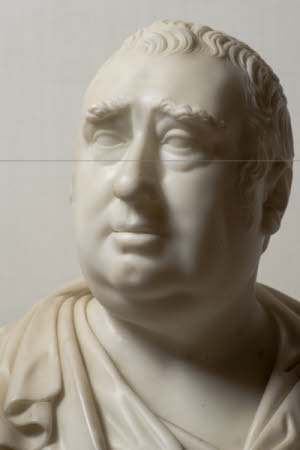
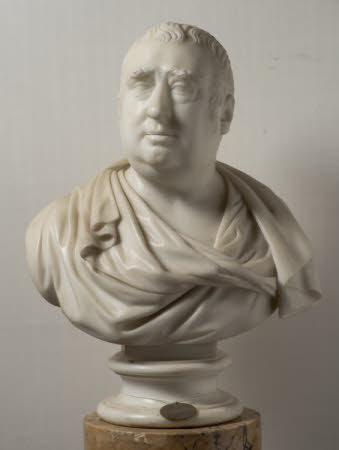
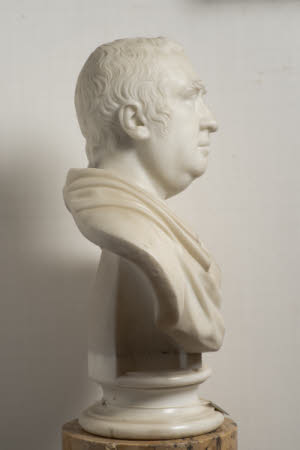
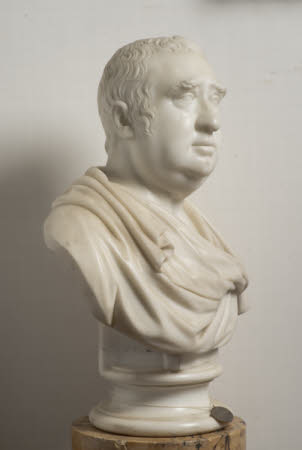
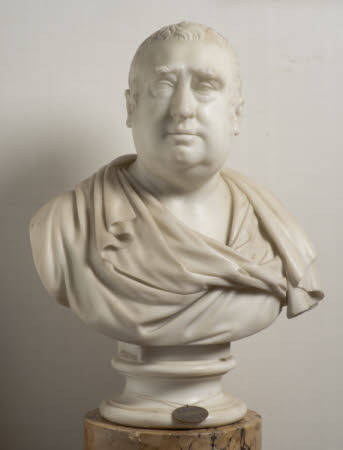
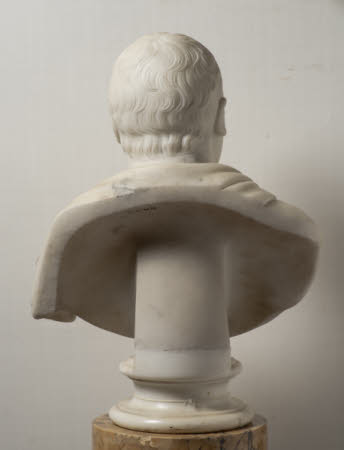
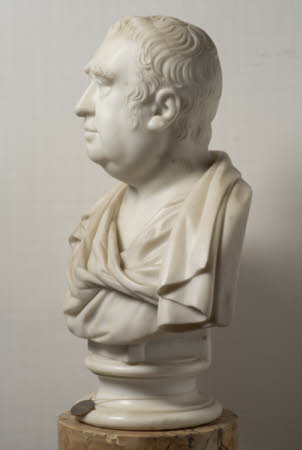
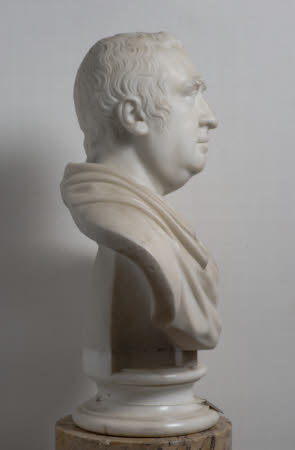
Portrait bust of the Rt. Hon. Charles James Fox MP (1749-1806)
attributed to Lorenzo Bartolini (Vernio, Tuscany 1777 – Florence 1850)
Category
Art / Sculpture
Date
c. 1818 - 1830
Materials
Marble
Measurements
606 x 407 x 28 mm
Place of origin
Florence
Order this imageCollection
Ickworth, Suffolk
NT 852213.1
Summary
Sculpture, marble; Portrait of the Rt. Hon. Charles James Fox MP (1749-1806); attributed to Lorenzo Bartolini (1770-1850), after a model by Joseph Nollekens (1737-1823); Italy, Florence, c. 1818-30. Charles James Fox was one of the most prominent figures in British public life in the second half of the eighteenth century, a radical MP who fought for liberty and people’s rights, a supporter of the American War of Independence and of the French Revolution, and a passionate opponent of the slave trade, in the abolition of which in 1807 he played an instrumental role. Charles James Fox wasthough no less well-known, indeed notorious for his debauched life style as a drinker, gambler and womanizer, although he eventually secretly married and settled happily with the former courtesan Elizabeth Armistead. Joseph Nollekens‘ portrait busts of Fox were among the sculptor’s most successful works, with at least fifty copies being made in his workshop in London. British collectors could also acquire highly competent copies for a fraction of the price from the workshop of the sculptor Lorenzo Bartolini, who was based in Florence and made large numbers of portraits of British visitors to the city, especially in the period c. 1815-30.
Full description
A portrait bust of the politician Charles James Fox, depicting the sitter draped in a toga, looking upwards and to his right. With a blank entablature below the bust, and mounted on a circular marble socle. Placed on a porphyry scagliola column (NT 252213.2). Charles James Fox (1749-1806) was, along with his great rival William Pitt the Younger, the most prominent British politician in the later decades of the eighteenth century and the first years of the new century. Whereas Pitt represented the Tory interest, Fox was a Whig who became deeply radical in the course of his career, supporting causes such as the American War of Independence, the French Revolution and the abolition of slavery. Fox was the son of Henry Fox, 1st Baron Holland, (1705-1774), who had been the chief Whig opponent of Pitt’s father ‘Pitt the Elder’, William Pitt, 1st Earl of Chatham (1708-1778), thus presaging his son’s own political struggles later in the century. The young Fox was famously spoilt by his father, being allowed to direct the own course of his schooling, which included Eton College and then Oxford, which he left without taking his degree. As a young man he travelled extensively in Europe, meeting leading political and literary figures such as Jean-Jacques Rousseau, Voltaire, David Hume and the marquis de Lafayette, who would prove influential in the development of his own views. Fox entered Parliament in 1768 and would remain active in politics for the remainder of his life, most of the time in opposition. His radical opinions developed gradually, firstly with support for the American colonies in the War of Independence, which he saw as a struggle for liberty against despotism, and which also greatly increased his dislike of his monarch, George III, an enthusiastic prosecutor of the war against the rebels. Fox also welcomed the French Revolution although he was less enthusiastic about Napoleon Bonaparte’s subsequent seizure of absolute power. He consistently championed tolerance and the liberty of the individual and, whilst he failed to make progress with Catholic emancipation, his single greatest political achievement came at the very end of his life, after Fox had been appointed Foreign Secretary in January 1806, in the ‘Ministry of all the Talents’ created following the death of William Pitt. Although his death in September 1806 meant that he would not see abolition enacted, it was Charles James Fox who successfully put through Parliament in June 1806 the motion for total abolition of the slave trade within the British Empire. Fox’s notoriety came not just from his political activities but also his personal life. From an early age he was a heavy gambler, running up eye-watering debts, a drinker and a womaniser, whose peccadilloes were exposed to public gaze through innumerable articles, pamphlets and caricatures – he was the subject of more satirical cartoons than any other person of his time. Joseph Nollekens made three portraits of Fox (Baker in London 2006, nos. 114-16). The first, commissioned in 1791 by Earl Fitzwilliam, has been described as ‘the sculptor’s masterpiece in the Baroque manner’ (Whinney 1992, pp. 299-302, fig. 214). It shows the sitter wearing a wig and with his head tuned sharply to his right, his eyes blazing, as if he were addressing the House of Commons. The original version of the bust, exhibited at the Royal Academy in 1791, was given to Empress Catherine of Russia and is now in the Hermitage, St Petersburg, whilst other versions are at Holkham Hall, and on loan to the Hunterian Museum, Glasgow. The example in Glasgow comes from the collection of the descendents of Charles James Fox’s long-time lover and companion, whom he married secretly, the former courtesan Elizabeth Armistead (1750-1842). Nollekens’ second version was exhibited at the Royal Academy in 1802 and is a less forceful image, in which Fox is shown still wearing a toga, but with the sitter’s head less sharply turned, whilst he is here without a wig, recalling Roman republican portraits. A decade on from the earlier bust, he appears here even more corpulent. Prime examples include those at Woburn Abbey and the Victoria & Albert Museum (Bilbey and Trusted 2000, no. 133; London 2006, no. 115). The third type was a bust made in 1805 for the MP William Smith, which shows the sitter in an even more severe classical manner, with his chest bare (National Portrait Gallery; London 2006, no. 116). The bust of Charles James Fox at Ickworth is exceptional and perhaps unique in that, although it uses the face from the 1802 portrait, this is here combined with the toga arrangement from Nollekens’ first 1791 portrait of Fox. Along with his bust of William Pitt the Younger, Nollekens’ second bust of Charles James Fox was his most successful sculpture, with some fifty replicas said to have been made in his workshop. The huge demand for copies of Nollekens’ portrait of Charles James Fox meant that replicas were made not only in the sculptor’s studio, but also elsewhere, including in the workshop of the Florentine sculptor Lorenzo Bartolini (1777-1850). After Europe had opened up once more to travel following the Battle of Waterloo and final defeat of Napoleon Bonaparte in 1815, Lorenzo Bartolini developed a highly successful business making portrait busts of visitors to Florence, many of them British and including the Hervey family. In 1818 or 1819 the 5th Earl of Bristol commissioned portraits of himself, now at Felbrigg (NT 1401967), his wife Elizabeth, at Ickworth (NT 852210) and their elder daughter Augusta, also at Ickworth (NT 852223 and 852215). John Kenworthy-Browne (2014) was the first to point out that the Ickworth bust of Charles James Fox, one of a group of portrait busts of the great politicians of the time assembled by the 5th Marquess, was likely also to be Bartolini’s work, an attribution that has since been accepted (Caputo and Melloni Franceschini 2016). Evidence for Lorenzo Bartolini having produced copies of the portrait busts of well-known British figures comes from the first-hand account by the lawyer Henry Matthews (1789-1828), who late in 1817 undertook a continental tour for his health, in the course of which he visited the studio of Lorenzo Bartolini in Florence, describing how ‘Bertolini (sic) is an excellent workman, and takes admirable likenesses […] It is now the fashion among the English to sit to him; - and you find all your acquaintance drawn up in fearful array, in hard marble; - some at full length!’ (Matthews 1820, p. 59). Matthews though went on to explain that cost was one reason why the British flocked to Bartolini: ‘The cheapness of sculpture here must injure our English artists. Casts have been imported from London of the busts of the King, Fox, Pitt, Nelson, Perceval, and many others. These Bertolini reproduces in marble, and sends back to London, for twenty-two pounds each.’ There are indeed plaster casts of the faces of Charles James Fox and William Pitt among the collection of casts from Bartolini’s studio now in the Galleria dell’Accademia in Florence. The Fox mask is based on the 1802 bust (Caputo and Melloni Francschini 2016, pp. 30-31), but given that the Ickworth bust uses the drapery formula from the 1791 portrait, it seems possible that a cast of that bust also found its way to Florence. It is easy to understand why commissioning busts in Florence must have seemed an attractive economic proposition for British visitors. Compared to the £22 price cited by Henry Matthews, it is known that Nollekens charged 120 guineas (£126) for studio marble copies of his bust of William Pitt (Nollekens and his Times, I, p. 371); the copies of the portrait of Fox are likely to have commanded a similar level of price. Kenworthy-Browne described the backs of the copies of Britis portraits made in Bartolini’s workshop as ‘quite unlike those of Nollekens’, but he also pointed to the distinctive handling of the hair; other features that may suggest the work of Bartolini and his workshop include faintly incised eyes, heavily pronounced eyelids and long nostrils. Many of the sculptures that were sold under the name of Lorenzo Bartolini in reality may hardly have been touched by the sculptor. Recent research has established how, as well as his assistants in his workshop in Florence, Bartolini made extensive use throughout his career of sculptors based in Carrara, notably Carlo and Giuseppe Rocchi (Caputo and Melloni Franceschini 2016, pp. 24-39). The Rocchi were subcontracted to make several busts of British sitters, but not as far as is known the various busts of members of the Hervey family commissioned from Lorenzo Bartolini, several of which remain at Ickworth (NT 852210, 852215, 852223). John Kenworthy-Browne mentioned a second bust of Charles James Fox as a product of Bartolini’s studio, but did not record its location. No doubt many of these busts made in Florence rather than in London remain to be identified. They do include a bust of William Pitt the Younger after Nollekens, sold from the collection of Professor Albert Richardson in 2013 (Christie’s, 18 September 2013, lot 47). It is possible that others from the group of portrait busts after models by Nollekens at Ickworth were also made in Bartolini’s studio. The Charles James Fox is one of four sculpted portraits of contemporary politicians that have been on display in the Library since 1830, when Bantings supplied scagliola columns for them. The others depict Robert Jenkinson, 2nd Earl of Liverpool (NT 852211), probably by the London-based sculptor Francis Hardenberg, George Canning (NT 852212) and William Pitt the Younger (NT 852214). All have until recently been believed to be autograph works by Joseph Nollekens. Jeremy Warren July 2025
Provenance
Part of the Bristol Collection. The house and contents were acquired through the National Land Fund and transferred to the National Trust in 1956.
Credit line
Ickworth, The Bristol Collection (acquired through the National Land Fund and transferred to The National Trust in 1956)
Makers and roles
attributed to Lorenzo Bartolini (Vernio, Tuscany 1777 – Florence 1850), sculptor after Joseph Nollekens, RA (London 1737 – London 1823), sculptor
References
Matthews, Henry, The diary of an invalid :, MDCCCXX. 1820 Smith, John Thomas, 1766-1833 Nollekens and his times: 1828. Gage, 1838: John Gage. The history and antiquities of Suffolk: Thingoe hundred. London: Printed by Samuel Bentley, Dorset Street; Pub.John Deck, Bury St. Edmund’s, and Samuel Bentley, Dorset Street, 1838., p. 307. Whinney 1992: Margaret D. Whinney, Sculpture in Britain, 1530-1830, Yale University Press, 1992 Bilbey and Trusted 2002: Diane Bilbey and Marjorie Trusted, British Sculpture 1470 to 2000, A Concise Catalogue of the Collection at the Victoria and Albert Museum, London 2002, pp.98-99, no.133 London 2006: Citizens and kings: portraits in the Age of Revolution 1760-1830, exh.cat., Royal Academy of Arts, London 2006 Roscoe 2009: I. Roscoe, E. Hardy and M. G. Sullivan, A Biographical Dictionary of Sculptors in Britain 1660-1851, New Haven and Yale 2009, p. 907, no. 248. Kenworthy-Browne 2014: John Kenworthy-Browne, ‘Rediscovering Bartolini’s busts and statues in Britain’ in Silvestra Bietoletti, Annarita Caputo and Franca Falletti, eds., Lorenzo Bartolini. Atti delle Giornate di Studio, Pistoia 2014, pp. 48-60, p. 54. Caputo and Melloni Franceschini 2016: Annarita Caputo and Silvia Melloni Franceschini, Lorenzo Bartolini. Nuove prospettive fra Carrara e Firenze, Pisa 2016, pp. 30-31.