The Birth of Prince James
attributed to George Bowers (fl.1660 - 1689)

Category
Coins and medals
Date
1688 (original medal)
Materials
Silvered copper-alloy
Measurements
30 mm (Diameter)
Place of origin
Great Britain
Order this imageCollection
Osterley Park and House, London
NT 773276.2
Summary
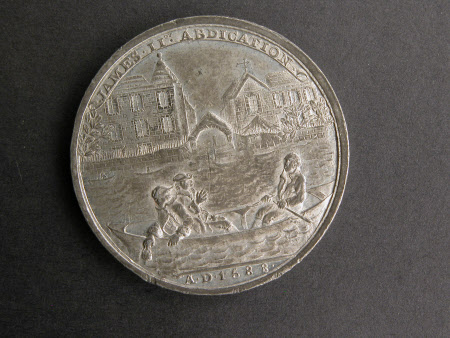
Silvered copper-alloy, medal commemorating the birth of Prince James, attributed to George Bower (fl. 1660-89), struck United Kingdom, later restrike of an original medal made 1688. A silvered copper medal commemorating the birth, on 10 June 1688, of Prince James Francis Edward Stuart (1688-1766), known later as The Old Pretender, to King James II/VII and his wife Mary of Modena. Obverse depicts the baby prince as the infant Hercules, lying in a cradle and strangling two serpents. The Latin legend translates as ‘Cradles give death to monsters’; in the exergue is a knot with a coronet. The reverse has the Prince’s plumes, with a coronet, and the legend ‘A coronet triply supported is to be reverenced’ and, in the exergue, the date 1688.
Full description
Prince James Francis Edward Stuart was born in St James’s Palace on 10 June 1688, the only surviving son of King James II/VII (1633-1701) and his wife Mary of Modena (1658-1718). Variously known in his lifetime as the Chevalier de St George, the Pretender and the Old Pretender, the Prince would subsequently become the focus for Jacobite hopes for the restoration of the Catholic Stuart line. The Prince’s birth was surrounded by controversy, speculation and innuendo. By 1687 it was widely supposed that Queen Mary, who had last given birth in 1683 and none of whose children had survived infancy, would never again bear children. The knowledge towards the end of 1687 that she was pregnant was therefore a considerable surprise, but also an unpleasant shock for many people, since by this time it had become clear that King James was determined to place the Catholic church on the same footing as the established Church of England, in his bid to effect full religious tolerance in Britain. The birth of a male child would mean a Catholic would precede in the succession James’s two daughters by his first marriage, Mary (later Queen Mary II, 1662-94) and Anne (Queen Anne, 1665-1714). Therefore, from the moment the Queen’s pregnancy was known, Protestant factions began to spread rumours that questioned the truth of her pregnancy or the paternity of the expected child. Princess Anne was one of those who helped fan such rumours by suggesting that the queen seemed far too healthy to be pregnant. When the time came for the birth, it took place in a room crowded with witnesses who, however, deliberately turned their backs so they could claim they were unable to testify that it was the queen who had given birth. The King tried in vain to quash a rumour that quickly sprang up, suggesting that the new baby had been smuggled in to the chamber within a warming pan, whilst other scurrilous suggestions included accusations that the real father of the child was the King’s Jesuit advisor Sir Edward Petre (see NT 773274). Medals were issued commemorating and commenting on the birth from both Catholic and Protestant standpoints.This particular work suggests that the serpents are the Protestant rumour-mongers, whose untruths would be silenced by the birth of the healthy child. The strangling of the serpents refers to the best-known story concerning the infancy of the mythological god and hero Hercules, celebrated for his superhuman strength. Because Hercules was the product of one of the many illicit liaisons enjoyed by Jupiter, king of the gods, the hero had throughout his life to beware the desire for vengeance of Jupiter’s spouse Juno. When he was still a baby, the goddess sent two poisonous snakes into the room in which the infant Hercules was sleeping in his cradle, but he picked them up and strangled them with his own hands. On the reverse, the three feathers within the Prince’s coronet symbolise the three kingdoms of England, Ireland and Scotland. The medal’s strongly anti-Protestant message provoked anger, contributing to riots in which Catholic churches became the objects of attacks. More broadly, the birth of a male heir triggered events that led to William of Orange’s invasion of Britain in November 1688 (see NT 773274 and 773314). In early December Queen Mary fled London for France, taking her infant son with her. Jeremy Warren 2019
Provenance
Given to the National Trust in 1993 by George Child Villiers, 9th Earl of Jersey (1910-1998).
Marks and inscriptions
Obverse, legend: MONSTRIS. DANT. FVNERA. CVNAE. Reverse, legend: FVLTA. TRIBVS. METVENDA. CORONA. Reverse, exergue: 1688
Makers and roles
attributed to George Bowers (fl.1660 - 1689), medallist
References
Hawkins, Franks and Grueber 1885: Edward Hawkins, Augustus W. Franks and Herbert A. Grueber (eds.), Medallic Illustrations of the History of Great Britain and Ireland to the death of George II, 2 vols., London 1885, vol. I, p. 628, no. 48. Skeet 1930: Francis John Angus Skeet, Stuart Papers, Pictures, Relics, Medals and Books in the Collection of Miss Maria Widdrington, Leeds 1930, p. 71. Woolf 1988: Noel Woolf, The Medallic Record of the Jacobite Movement, London 1988, p. 15, no. 3:10. Eimer 2010: Christopher Eimer, British Commemorative Medals and their Values, London 2010, p. 64, no. 294, Pl. 37.