Model junk
Category
Ivory and bone
Date
1750 - 1775
Materials
Ivory, painted; glass and brass
Measurements
540 x 850 x 330 mm
Place of origin
Guangzhou
Order this imageCollection
Osterley Park and House, London
NT 771742.2.1
Summary
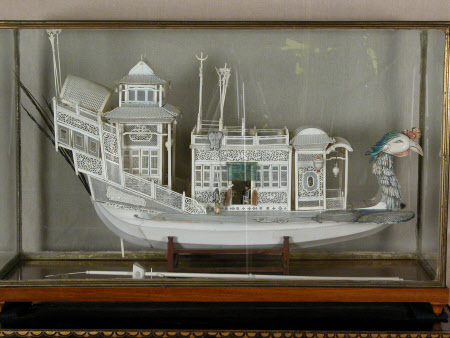
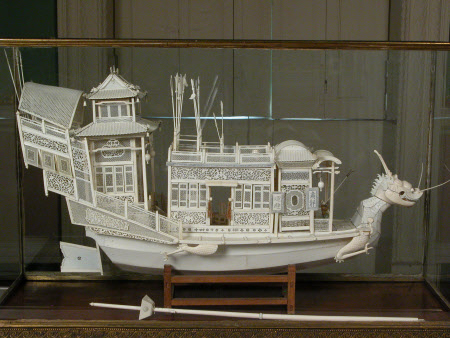
Model of a Chinese sampan, one of a pair, painted ivory on wooden bases with glass cover. On the sampan there is a 'house' with a portico in the middle, a second 'house' with a second level at the end, with a phoenix head at the front. Spheres and lamps on the roof of the houses in the middle. The vessels were known as 'Royal Junks', the dragon prow for the Emperor and the phoenix for the Empress. The base is rectangular veneered with walnut, inlaid with stringing lines in a light wood round the edge. There is a brass strip with a guilloche motif along each side and a tapered brass foot at each corner. A simplified version of the original base on was made for this model in 1977.
Full description
Model of a Sampan with a dragon prow, made in Guangzhou (Canton), circa 1750-75. Canton artisans were skilled in carving ivory imported from South and South-East Asia. Sampan or pleasure boats were a familiar sight to visitors to Canton and these models were made as novel souvenirs for Western visitors. A similar model in the VIctoria and Albert Museum was acquired in Canton by Richard Hall (1764-1834), the 'supercargo' or senior officer in charge of the East India Company's operations in China between 1785 and 1802.It was propelled by a clockwork motor.Child Family Heirlooms. The 1782 inventory records in the [Long] Gallery 'Two India Sandpans[Sampans] of Ivory with Plate Glass Cases in brass frames on two and gold Japanned Tables'.
Provenance
Child Family Heirlooms. The 1782 inventory records in the [Long] Gallery 'Two India Sandpans[Sampans] of Ivory with Plate Glass Cases in brass frames on two and gold Japanned Tables'
Marks and inscriptions
Behind Phoneix's head when facing the viewer (under roof edge): 雅樂 雅 – elegant, refined, graceful 樂 – happiness, joy, music elegant music or refined joy The combination of these two words historically refers to ancient Chinese court music, especially ritual and ceremonial music played at imperial and formal events. RHS of Phoenix's head when facing the viewer: 龍飛乘阆阙 龍 – dragon, symbolizing power, majesty, and divine authority. 飛 – to fly, soar, ascend. 乘 – to ride, ascend 閬闕 – palace, imperial gate, or grand structure, often referring to royal or celestial buildings. The dragon soars, riding the celestial palace gates. The phrase may represent a site of great prestige, imperial power, or celestial importance. Behind Phoenix's head (when facing the viewer (second 'building') under roof edge): 凤阁 凤 – phoenix, a mythical bird symbolizing royalty, elegance, and auspiciousness. 阁 – pavilion, tower, or chamber, often referring to an elegant or important building. phoenix pavilion or elegant chamber of the phoenix.