Picture of "Gray"
Henry Scott Augustus Tuke, RA (York 1858 - Falmouth 1929)
Category
Art / Oil paintings
Date
c. 1922
Materials
Oil on canvas
Measurements
425 x 527 mm (16 3/4 x 20 3/4 in)
Order this imageCollection
Clouds Hill, Dorset
NT 628439
Summary
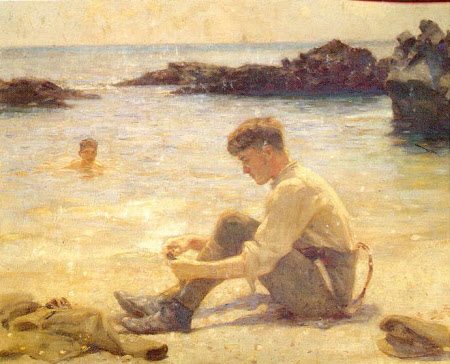
Picture of “Gray”, oil painting on canvas, by Henry Scott Tuke (York 1858 - Falmouth 1929), c. 1922. A painting of a blond soldier sitting sideways on a sandy beach in white shirt and khaki trousers in bright sunshine. His uniform of tunic and cap are discarded in the foreground. He holds the puttee of his left calf in his hands, presumably unwinding them in order to undress and join the other figure swimming in the rocky cove beyond. The date next to the artist’s signature has been scratch out when dry. There is evidence that T.E. Lawrence (Lawrence of Arabia) modelled for the main figure in 1922.
Full description
This painting depicts a young soldier undressing on the beach of a small cove in bright sunshine. Another youth is already swimming in the sea. The badge on the discarded cap identifies the uniform as that of the Cornwall Royal Garrison Artillery which was amalgamated with the Royal Field Artillery in 1924. The rock formations in the background identify the location as a small bay near Falmouth called Newporth Beach, accessible only by small craft and often used by Tuke as a setting for his paintings. Tuke specialised in idyllic paintings of adolescent boys and young men bathing in the sea. For these he used multiple models, usually drawn from the local working class population, amalgamating their features and bodies into single figures to realistic effect. There is evidence that T.E. Lawrence (Lawrence of Arabia) was one of the principal model for this painting, which now hangs in his Dorset retreat, Clouds Hill. Lawrence’s younger brother, Arnold, retrieved the painting from Clouds Hill before giving the cottage to the National Trust in 1936 following his brother’s death. Later, in 1963, he also gave the painting to the National Trust so it could hang in the cottage, believing it to be a picture of his brother in his youth. The figure in the painting shares Lawrence’s yellow blond hair, straight nose, strong chin, and youthful occipital protuberance at the back of the skull. Lawrence certainly did model for Tuke. In autumn 1935, Captain Rupert de la Bere of RAF College Cranwell recalled a conversation with Lawrence in spring of that year in which they had ‘talked together of Tuke’. Lawrence told Captain de la Bere that ‘he had often been a model for Tuke in his youth’. Lawrence also owned the pendant pair to the present painting and gave it to his friend, Clare Sydney Smith, at which time he was in the RAF, going by one of his many aliases, T.E. Shaw. She published the pendant painting, also depicting a young bather as ‘A Painting of T.E.S.’. In a letter to another artist of November 1928, in which Lawrence declined to sit for a formal portrait but expressed willingness to serve as a model, he said: if you are like the artist who said, “Do sit: I really can’t afford a proper model…” then by all means. He worked what was left of his study of me into a beach picture; after giving me a new head, several sizes smaller. This corresponds to Tuke’s practice of making outdoor oil sketches of his models and then referring to these in aid of finished works in the studio, transforming them in the process. The painting is first recorded in Tuke’s manuscript Registers of paintings, in which he kept track of the creation, title, exhibition and subsequent purchase of his works. He describes the picture as ‘An RGA soldier seated on the beach’ but gives it the title ‘Picture of “Gray”’. It is listed alongside ‘Small Bathing Picture’, the pendant work later given to Sydney Smith. The price of each work is listed as twenty-six pounds and five shillings and the original purchaser of both is identified as R.F.C. Scott. He subsequently added, ‘When R.F.C. Scott died “Gray” bought these two at the sale of his effects for a fiver!’ This shows that the named model for the picture also later bought both pictures on the secondary market. The use of quotation marks around a name in the Registers is anomalous, indicating that “Gray” is an alias. Unless another of Tuke’s blond models can be identified as an owner the two paintings, intervening between Scott’s and Lawrence’s ownership, it seems likely that “Gray” is one of Lawrence’s multiple aliases. As most of Tuke’s models were working-class Falmouth locals, the probability that another candidate for “Gray” will emerge is low. No date for the pair of paintings is recorded in the Registers but the entries follow the chronological order of production. They appear immediately after ‘Morning Splendour’ which was painted in the summer of 1921, indicating a subsequent date for the ‘Picture of “Gray’”. Lawrence was in Cornwall on two-weeks’ leave from the Colonial Office in June 1922, creating a window of opportunity for him to model for Tuke. If Lawrence’s letter of 1928 refers to the present painting, Tuke took some years off his model, who was 34 in 1922, as well as reducing the size of his large head. Although his ‘juvenile’ appearance was still being commented upon as late as 1929. A misreading of the entry in the 1983 transcribed edition of the Registers led to additional confusion about the painting. The commentary on the entry described ‘Picture of “Gray”’ and ‘Small Bathing Picture’ as preparatory sketches for ‘Morning Splendour’ because they are small and share a setting with the larger work. This ignores the chronological order of the Registers and the fact that sketches are referred to as such in their entry titles. Based on this misreading, historian Charles Grosvenor suggested that the ‘Picture of “Gray”’ might therefore have begun as a preparatory sketch commenced prior to 1921’s ‘Morning Splendour’, which was then reworked using Lawrence as a model in 1922. This was also proposed as an explanation for the difficulty in reading the date next to artist’s signature, the inscription having been imperfectly altered by the artist from 1921 to 1922. However, technical analysis of the painting during conservation in 2024 using microscopy and infrared radiography, showed no evidence that the finished surface was painted over a preparatory sketch. Interestingly, the date was shown to have been totally rubbed off after the paint had dried – a highly unusual circumstance for which there is no obvious explanation. If the evidence pointing to Tuke using Lawrence as a model for ‘Picture of “Gray”’ can be relied upon, this scenario may explain why he valued the painting enough to include it among the very small number of possessions possible to house at Clouds Hill. Lawrence told his young friend in the Tank Corps, Alec Dixon, that Tuke was one of his favourite artists. His love of his seaside idylls may have stretched as far back as his Oxford school days, when his older friend at that time, the curator Clive Francis Bell, was acquiring Tuke pieces for the Ashmolean Museum. Here was a painting that not only embodied the qualities Lawrence admired in Tuke’s art but perhaps the memory of a period of respite - modelling for a revered artist - following the completion of the manuscript for 'The Pillar of Wisdom' in February 1922. This shimmering, idealised image of a young RGA recruit at leisure was never a straightforward portrait of anyone, but there’s evidence to suggest that its principal model was Lawrence. John Chu 2026
Provenance
Sold as 'Picture of "Gray"' to R. F. C. Scott for £26 5s; sold to “Gray”, identified as T.E. Lawrence, in 1926 for £5; inherited by Arnold W. Lawrence in 1935; given to the National Trust in 1963.
Credit line
Clouds Hill, The T. E. Lawrence Collection (National Trust)
Marks and inscriptions
Recto: bottom right: date and signature scratched out; possibly H.S. TUKE 1922
Makers and roles
Henry Scott Augustus Tuke, RA (York 1858 - Falmouth 1929), artist
References
Charles Grosvenor, An Iconography: The Portraits of T. E. Lawrence, Pasadena 1988, pp.114 - 15 no. 53