Hercules
John Michael Rysbrack (Antwerp 1684 – London 1770)
Category
Art / Sculpture
Date
1756 (signed and dated)
Materials
Marble
Measurements
1855 mm (Height)
Place of origin
London
Order this imageCollection
Stourhead, Wiltshire
NT 562911
Caption
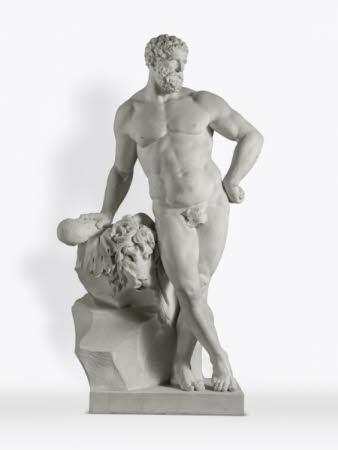
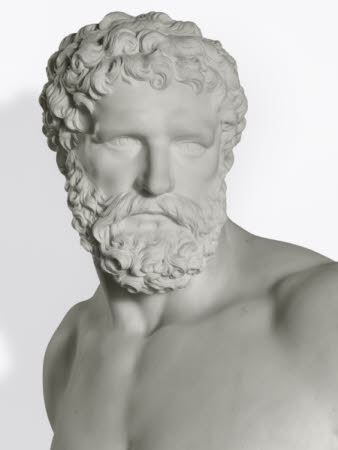
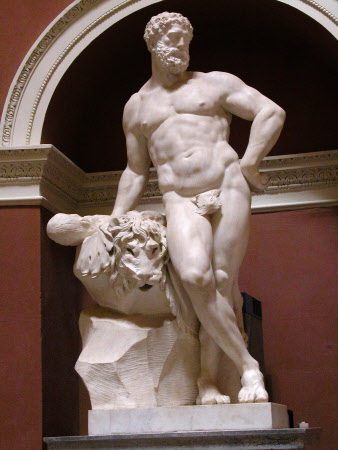
For his sculpture of the mythical hero Hercules, John Michael Rysbrack (1694–1770) was inspired by classical sources. He was particularly influenced by images and copies of the Farnese Hercules (now in the Museo Archeologico Nazionale, Naples), but he also relied on many different live models to help him accurately render the human anatomy. A contemporary commentator records that Rysbrack modelled the arms on those of a local bare-knuckle boxer known as Jack Broughton, the torso on a coachman and the legs on a well-built painter. The statue, signed and dated, took ten years to complete and was the artist’s most impressive and celebrated work. It was commissioned by Henry Hoare II (1705–85) for his purpose-built Temple of Hercules within a designed parkland at Stourhead in Wiltshire. It cost the very considerable sum of £350, the equivalent of more than £40,000 today. The temple has since been renamed the Pantheon, and the statue is set in a niche alongside a pendent sculpture of the Roman goddess Flora, also by Rysbrack.
Summary
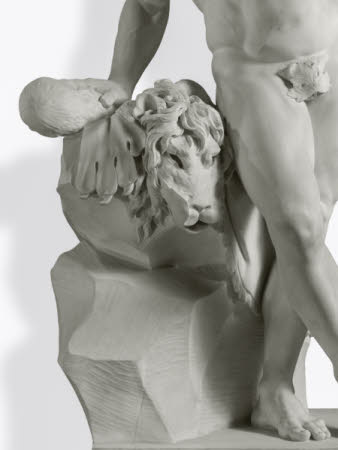
Marble, Hercules, John Michael Rysbrack (1694-1770), 1756, signed and dated ‘Mich. Rysbrack 1756’. A colossal marble statue of Hercules, nude with the exception of a fig leaf, standing in contrapposto looking out to proper left. The figure is shown leaning against a boulder, holding his club in the proper right hand and resting it on the pelt of the Nemean lion which is draped over the boulder. The top of his proper left hand rests on the left hip; Mounted on a marble base and grey marble pedestal supplied by Rysbrack (NT 562911.2).
Full description
Described by Horace Walpole as Rysbrack’s ‘chef d’oevre’, this colossal statue of Hercules was commissioned by Henry Hoare II (1705-85) in 1747 and later mounted as ‘the principal ornament’ in the Pantheon at Stourhead (Walpole quoted in Webb 1950, p.311). The statue originates from a terracotta model of 1744 (NT 732894) which was bequeathed to Hoare in the sculptor’s will and which is featured in the famous portrait of Rysbrack by Andrea Soldi, painted in 1753 (Yale Center for British Art, Paul Mellon Collection, B1976.7.75). A paper agreement of July 1747 records the details of the commission: Rysbrack and Hoare, a life-long patron of the sculptor, settled on ‘the sum of three hundred pounds’ for a ‘Hercules in statuary marble six feet three inches high’, with plinth, ‘finish’d according to the model [i.e. the terracotta] agreed on’. A deposit of ‘one Hundred and fifty pounds’ was paid at the start, with ‘seventy five pounds’ promised half-way through, and the ‘remaining seventy five pounds’ payable upon completion. A note inscribed on the same piece of paper, but dated July 1752, shows that work had only then just begun, five years after the agreement was drawn up. Despite waiting nine years for his Hercules, Hoare was delighted with the final result, paying the sculptor a further £50 ‘beyond ye Contract’ in July 1757. In 1760 Rysbrack completed a companion statue of the Farnese Flora at the cost of £200 (NT 562912.1, the terracotta model is in the Victoria and Albert Museum, London, inv.no. A.9-1961). The sculpture is an intriguing composite, incorporating the head of the prototype Farnese Hercules (Museo Archeologico Nazionale, Naples), and, according to Horace Walpole, various bodily 'parts and limbs of seven or eight of the strongest and best made men in London’, chiefly ‘bruisers and boxers’ (Walpole quoted in Webb 1950, p.311). ‘The arms were Broughton’s [i.e. Jack Broughton (1703/4-89), an English bare-knuckle boxer], the breast a celebrated coachman’s, a bruiser, and the legs were those of Ellis the painter’, a ‘great frequenter’ of a London ‘gymnasium’ (ibid). The figure's overall stance originated from an engraving after Pietro da Cortona (1596-1669) published as the frontispiece to Ferrari’s Hesperides (1646), a folio Rysbrack himself owned (Kenworthy-Brown 1983, pp.216-9; for an impression see British Museum, London, 1872,0511.1154). See also the associated terracotta bust of Hercules by Rysbrack in the collection of the Yale Center for British Art (B1977.14.28). Alice Rylance-Watson 2019
Provenance
Commissioned July 1747 by Henry Hoare II from John Michael Rysbrack (Wiltshire Record Office 383.4) and purchased for £350 (paid in instalments from July 1752 to July 1757); thence by descent; given to the National Trust with the house, grounds, and rest of contents by Sir Henry Hugh Arthur Hoare (1865–1947) in 1946.
Credit line
Stourhead, The Hoare Collection (The National Trust)
Marks and inscriptions
Mich. Rysbrack 1756
Makers and roles
John Michael Rysbrack (Antwerp 1684 – London 1770), sculptor
References
Walpole, Horace, 1717-1797 Anecdotes of painting in England; : M.DCC.LXXXII. [1782] Webb 1950: Marjorie Isabel Webb, 'Sculpture by Rysbrack at Stourhead', Burlington Magazine, 92, November 1950 Eustace 1982: Katharine Eustace, Michael Rysbrack, sculptor, 1694-1770, exh.cat. venue: Bristol Museum and Art Gallery, Bristol, 1982 Kenworthy-Browne 1983: John Kenworthy-Browne, 'Rysbrack, "Hercules", and Pietro da Cortona', The Burlington Magazine, vol.125, no.961 (April 1983)