Caryatid
Coade

Category
Art / Sculpture
Date
1793 (signed and dated)
Materials
Coade stone
Measurements
1920 x 600 x 400 mm
Place of origin
Lambeth
Order this imageCollection
Anglesey Abbey, Cambridgeshire
NT 516655.5
Summary
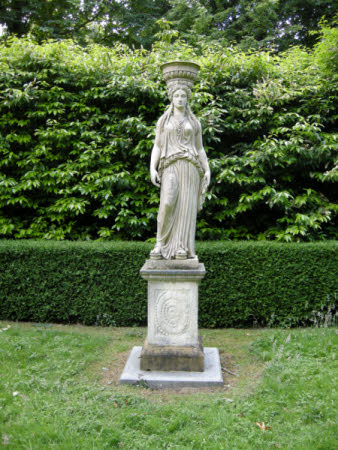
Coade stone, caryatid, Coade & Sealy, 1793. One of six over-life-size caryatids moulded of Coade artificial stone and based on figures from the Porch of the Caryatids of the Erechtheion on the Acropolis in Athens and on caryatids at Hadrian’s Villa, Tivoli. The base inscribed ‘COADE LAMBETH/1793’. Removed from Buckingham House, 1908. The caryatid as a Greek maiden wearing peplos gathered in the palm of the proper left hand, with proper right arm resting by the side. Standing on platform sandals with weight bearing on the proper left leg, the proper right knee bent forward. Hair coiffed in waves with centre parting and knot and long ringlets falling over both shoulders. The head surmounted by a capital enriched with bead-and-reel and egg-and-dart moulding. Mounted on Coade stone base and stone pedestal enriched with rosette mouldings.
Full description
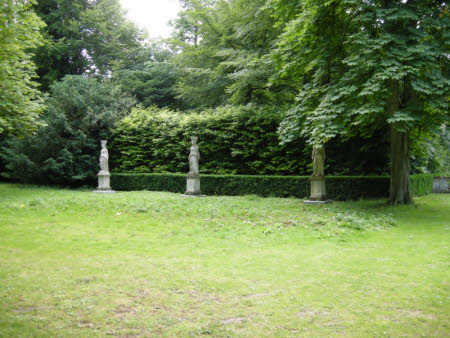
On the basis of the date ‘1793’ inscribed on three of the bases, these statues have been convincingly identified as among those which once held up the dome of the oval lantern above the staircase at Buckingham House, Pall Mall, rebuilt by John Soane (1753-1837) for the first Marquis of Buckingham in 1792-95 (Kelly 1989, p.251). A preliminary design by Soane (reproduced in Stroud 1992, pl.92) showing a section of the staircase hall includes seven caryatids, five along the side and one at each end, suggesting a complement of either twelve or fourteen in all. However a later watercolour by Soane shows four caryatids arranged round the end of the oval hall, rather than along the side, where there is no longer a cornice (reproduced in Stroud 1992, pl.93, and in Saumarez-Smith 1993, no.293), indicating that the design was altered, and Soane was eventually only billed for eight figures (Kelly, art. cit). The caryatids were presumably bought by Lord Fairhaven for Anglesey Abbey at some point after 1926, the figures retaining traces of black paint used to bronze them for Buckingham House. A photograph reproduced by Lanning Roper (1964) shows the caryatids at the junction of Cross Avenue, Anglesey Abbey, surmounted by ‘enormous terracotta baskets of a later date’, possibly the form in which they were bought by Lord Fairhaven, but subsequently removed (Roper 1964, p. 50, pls. 23b, 24b). Buckingham House appears to have been the first use of Eleanor Coade’s ‘Caryatid’ model, designed before Lord Elgin brought back the Pentelic marble caryatid from the Erechtheion (1816; British Museum, London, inv.no. 1816,0610.128). It evidently became a favourite with Soane, who, in 1795, ordered 12 of the same for the dome of the Rotunda of the Bank of England. Without the surmounting capitals, the caryatids can also be seen on the exteriors of Pitzhanger Manor, Soane’s country house in Ealing (1802), and on the loggia of No. 13 Lincoln’s Inn Fields (1812), his London town house. Coade ornament was used in one of Soane’s earliest dated buildings, a house at Adam’s Place, Southwark (1780-2), and continued to be used throughout the architect’s career, long after Eleanor Coade’s death. Soane’s personal copy of the 'Etchings of Coade's Artificial Stone Manufacture', a collection of 778 etched designs published in letterpress in 1784, is in the library of Sir John Soane’s Museum, London (no. 6861). Alice Rylance-Watson 2019
Provenance
Presumably acquired by Urban Huttleston Rogers Broughton, 1st Lord Fairhaven (1896-1966), after 1926; bequeathed by Lord Fairhaven in 1966 to the National Trust with the house and the rest of its contents.
Credit line
Anglesey Abbey, The Fairhaven Collection (The National Trust)
Marks and inscriptions
Base, front, proper left : COADE LAMBETH/1793
Makers and roles
Coade, manufacturer
References
Kelly 1985: Alison Kelly, 'Coade stone in Georgian architecture', Journal of the Society of Architectural Historians of Great Britain 28 (1985), pp. 71--95., p. 89. Kelly 1989: Alison Kelly, ‘Sir John Soane and Mrs Eleanor Coade’, Apollo, April 1989, pp. 247-253., p. 251. Kelly 1990: Alison Kelly, Mrs Coade's stone, Upton-upon-Severn 1990, pp. 134-5. Stroud 1984: Dorothy Stroud, Sir John Soane, Architect, London 1984, pls. 92-3. Saumarez-Smith 1993: Charles Saumarez Smith, Eighteenth Century Decoration: Design and the Domestic Interior in England, New York, 1993, no. 293. Roper 1964: Lanning Roper, The Gardens of Anglesey Abbey, Cambridgeshire. The Home of Lord Fairhaven, London 1964, p. 50, pls. 23b, 24b. Christie, Manson & Woods 1971: The National Trust, Anglesey Abbey, Cambridge. Inventory: Furniture, Textiles, Porcelain, Bronzes, Sculpture and Garden Ornaments’, 1971, p. 170.