Funerary stele for Arkesis
Category
Art / Sculpture
Date
circa 400 BC - circa 360 BC
Materials
Marble
Measurements
1200 x 360 mm
Place of origin
Athens
Order this imageCollection
Lyme, Cheshire
NT 500255.3
Summary
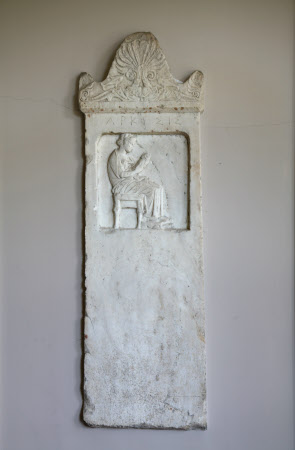
Marble stele (slab) of the fourth century BC, from Athens, commemorating a deceased female individual. A stele with shallow recessed panel representing in low relief of a young woman holding a swaddled baby. A Greek inscription records the name of the deceased, ‘Arkesis’.
Full description
A stele of white marble with shallow recessed panel crowned with an anthemion with acroteria decorated with acanthus foliage at the base of which grows a central palmette; there are lateral half-palmettes. The Greek inscription, bearing the name of the deceased, ‘Arkesis’, is located in the area between the anthemion and the recessed panel. It is written in letters of the style of the early fourth century BC. The stele is complete and in good condition with the exception of damage to the acroteria and chips to the edges and surface of the stele. Within the recessed panel a composition in low relief depicts a young woman holding a swaddled baby and gazing at it. The woman’s feet rest on a low footstool. For more discussion, see the Attic Inscriptions Online: https://www.atticinscriptions.com/inscription/AIUK5/1 (Peter Liddel, October 2021)
Provenance
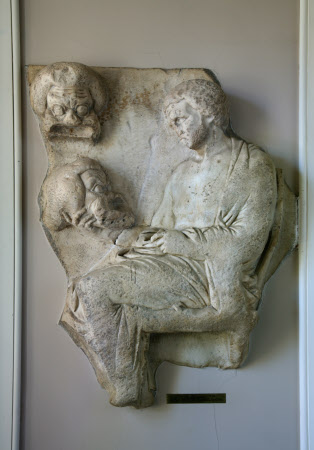
Collected by Thomas Legh (1792-1857, who inherited the Lyme estate in 1797), in 1811 or 1821, probably in Athens, possibly in area of the Kerameikos cemetery. This object, along with another funerary stele and a piece of inscribed sculpture, were installed in Lyme Hall’s remodelled Library for Thomas Legh by the architect Lewis Wyatt.
Marks and inscriptions
ARKE[S]I[S] (Carved above the relief)
References
Attic Inscriptions Online translation and commentary: https://www.atticinscriptions.com/inscription/AIUK5/2 Liddel and Low 2019: Peter Liddel and Polly Low, Attic Inscriptions in UK Collections. Volume 5. Lyme Park (2019). Online publication: https://www.atticinscriptions.com/papers/aiuk/-5/ Liddel & Low 2021: Peter Liddel & Polly Low 'Ancient Athenian Inscriptions at Petworth House, Lyme and Mount Stewart', National Trust Art, Buildings and Collections Bulletin, Autumn 2021, pp. 22-6 Oliver 2000: G.J. Oliver, ‘Images of Death: Inscribed Funerary Monuments from Fourth-Century Athens in Neo-Classical England’, in A. Cooley (ed.), The Afterlife of Epigraphy, Bulletin of the Institute of Classical Studies Supplement 75 (2000), 125-41. Strong, Eugénie, 1860-1943 Three sculptured stelai : in the possession of Lord Newton at Lyme Park / [1903]