The Medici Vase
Category
Art / Sculpture
Date
circa 1780 - circa 1850
Materials
Bronze
Measurements
470 x 210 x 210 mm
Place of origin
Rome
Order this imageCollection
Belton House, Lincolnshire
NT 435419.1
Summary
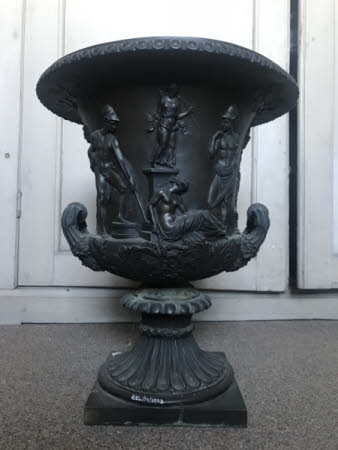
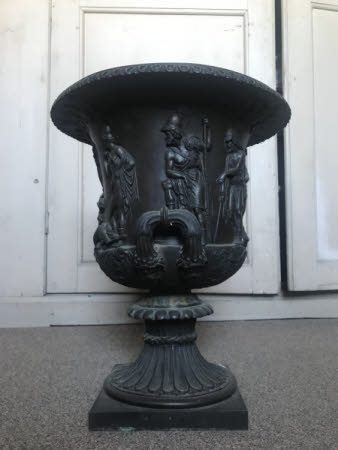
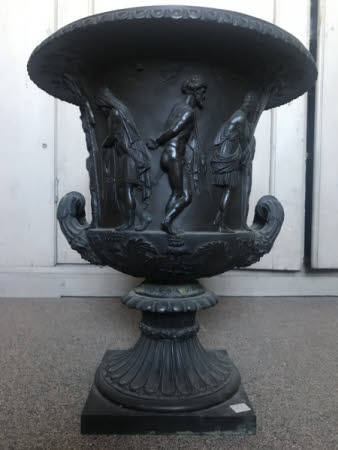
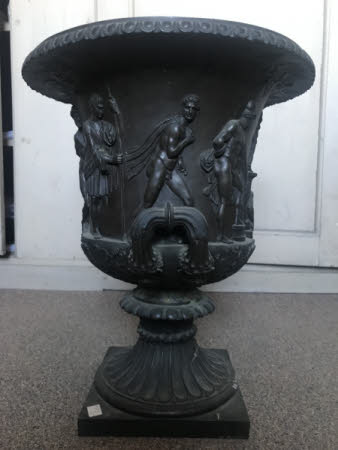
Bronze, The Medici Vase, Italian, c.1780-1850, after the antique. One of a pair with NT 435419.2. The vase decorated with a vine motif and a relief believed to show the story of Iphigenia. Below is a frieze of acanthus leaves and two fluted loop handles rising from paired satyrs’ heads on either sides. The vase is mounted on a tapering fluted stem and a square plinth.
Full description
This is a bronze reduction of the original Medici Vase, a monumental marble krater made in Athens in the second half of the 1st century AD. The original is first recorded in the inventory of the Villa Medici, Rome, in 1598 (Haskell and Penny 1891, no.82, p.316). It was removed to Florence in 1780 and displayed soon after in the Uffizi where it remains today. The relief is traditionally interpreted as showing the story of Iphigenia. She is the half-draped female seated below a statue of a goddess, Diana. The warriors at her side are possibly Agamemnon and Achilles or Odysseus. Iphigenia has been sacrificed to Diana by her father Agamemnon so that the goddess would allow the Greek ships to sail for Troy. Popular as garden and interior ornaments, copies of the Medici Vase were regularly sold as a pair with the equally celebrated Borghese Vase. A full-size copy by Bartolini (1777-1850) was made for the Orangery at Chatsworth (Haskell and Penny 1981, no.82, p.361) and high quality bronze reductions were produced in Rome from the late 18th century by Francesco Righetti (1738-1819) and Giacomo (c. 1731-85) and Giovanni Zoffoli (c.1745-1805). A signed example by Zoffoli is at Saltram (NT 871621.7), whilst another unsigned reduction at Osterley (NT 771969.2) is likely to have been made in Rome around the same time. See also bronze copies at Penrhyn Castle (NT 1421796.2) and Hinton Ampner (NT 1529966.2). Alice Rylance-Watson October 2018
Provenance
Purchased with a grant from the National Heritage Memorial Fund (NHMF) from Edward John Peregrine Cust, 7th Baron Brownlow, C. St J. (b.1936) in 1984.
Credit line
Belton House, The Brownlow Collection (acquired with the help of the National Heritage Memorial Fund by the National Trust in 1994)
References
Haskell and Penny 1981: Francis Haskell and Nicholas Penny, Taste and the Antique, The Lure of Classical Sculpture 1500 - 1900, New Haven and London, 1981, no.82, p.316