Tazza
Category
Objets de vertu
Date
1875 - 1900
Materials
Gilt metal, enamel, rock crystal
Measurements
150 x 90 mm
Place of origin
Vienna
Order this imageCollection
Tyntesfield, North Somerset
NT 15724
Summary
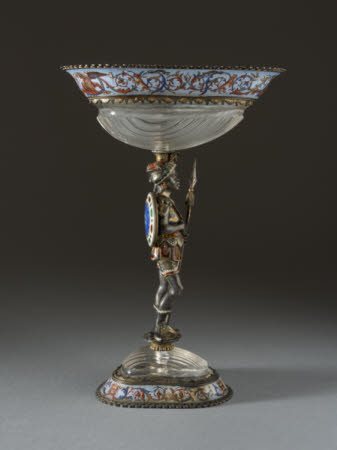
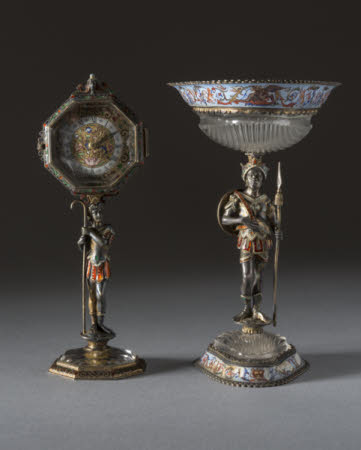
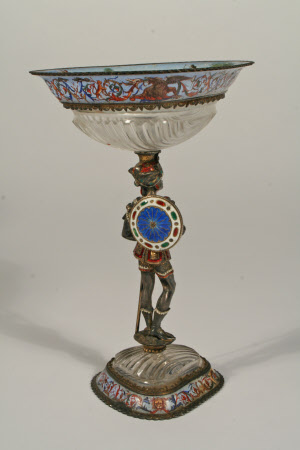
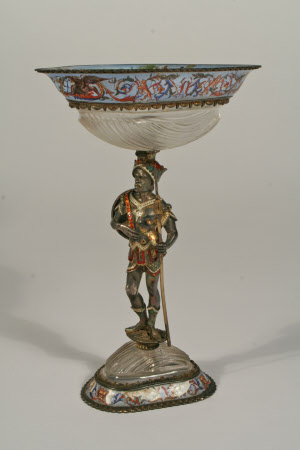
A gilt metal and enamel-mounted rock crystal tazza, Vienna, Austria, circa 1875-1900, in the Renaissance style. A ribbed shell-shaped rock crystal bowl with moulded gilt metal and enamelwork border, the exterior enamelwork with polychrome arabesque and grotesque motifs, the interior with highly-stylised scenes from the continent of Africa. The bowl is mounted on a figural stem in the form of a high-stylised African warrior. The figure of silver-gilt, carrying a gilt metal spear and shield, the shield with polychrome enamelwork. The warrior's clothing in elaborate polychrome enamelwork. The foot of ribbed, shell-shaped rock crystal with moulded gilt metal and enamelwork border. There is some loss of enamel to the foot.
Full description
The stem figure derives from a European aesthetic tradition called the ‘blackamoor’, a conflation of the Black African and Muslim ‘Moor’. In material culture the term was used to describe highly stylised representations of Black African people, wearing exotic and orientalised costume and often assuming subservient positions. The motif has existed in western decorative art since the medieval period but developed into a recognisable type in Italy, chiefly Venice, from the 17th century. The ornamental body of the ‘blackamoor’ could also perform a function, as a supportive element in furniture, or as a stand to hold objects or food - here the literal stem supporting a crystal tazza bowl. The motif is seen across European decorative arts from ceramics to silverware, heraldry to jewellery, furniture to sculpture, architecture, painting and print (e.g. NT 1254497, 452977, 936871, 118826, 129512, 802613, 1139940). ‘Blackamoor’ figures were manufactured for the luxury European market and displayed by their owners as markers of power and wealth.
Provenance
Purchased from the estate of the late Lord Wraxall with the assistance of the NHMF and donations from members and supporters.