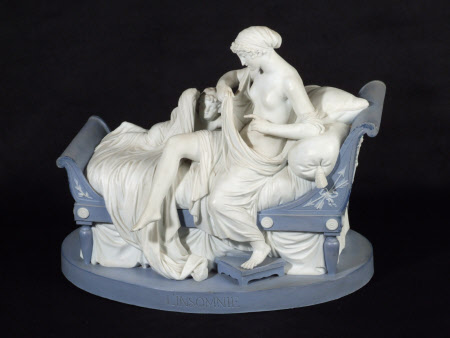
L'Insomnie ('The Sleepless Night')
Sèvres Porcelain Manufactory
Category
Ceramics
Date
circa 1801 - 1820
Materials
hard-paste biscuit (unglazed) porcelain, partially tinted in pale colbalt blue (pâte bleue);
Measurements
27.0 cm (H)30.5 cm (Length)23.0 cm (D)
Place of origin
Sèvres
Order this imageCollection
Hinton Ampner, Hampshire
NT 1529410.1
Summary
L'Insomnie ('The Sleepless Night'), figure group, hard-paste biscuit (unglazed) porcelain, partially tinted in pale colbalt blue (pâte bleue); sculpted by Louis-Simon Boizot, made at the Sèvres porcelain factory, France, ca. 1801-20.
Full description
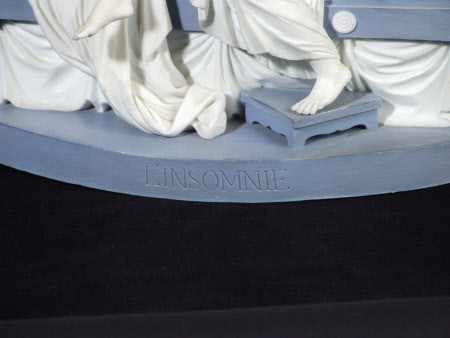
The two groups in biscuit (unglazed) porcelain, L'Insomnie ('The Sleepless Night') and Le Bain ('The Bath') are models first recorded at the Sèvres porcelain manufactory in 1799 and 1800. They are exceptional not only for their technique – each is partially tinted or stained in cobalt blue – but also for their depiction of furniture. Their subject is the toilette of Venus at dusk and dawn , attended by playful amorini. L’Insomnie, named after the inscription impressed on its base, depicts a partially draped Venus sitting on the edge of a lit en bateau (a boat-shaped bed), imitating the form of a tall Roman lectus or couch, which required a low stool to mount. The blue bed frame is decorated with amorous trophies in contrasting white biscuit, imitating ormolu mounts. Venus’s hair is covered in a Grecian saccos, a sac-like headdress resembling the revolutionary Phrygian cap. She is intently searching for fleas, the cause of her insomnia, and her nightdress has slipped off her shoulder exposing her breasts. Beside her, a triumphant cupid holds up a flea between his fingers. The subject, also known as La Chercheuse de Puces (‘The Hunter of Fleas’), was an intimate activity with erotic overtones, traditionally used by artists as a pretext to introduce female nudity. The other group is equally suggestive. Le Bain – the title is documented in the manufactury’s firing records – represents a partially draped female figure resting at the edge of a Roman bath, while wringing out her long wet hair. The sarcophagus-form bath, supported on four tortoises, has lion’s head masks at each end and pendant rings. A fashionable Roman stool by the bath awaits the slippery amorino, who clamours to get out of the bath. In evoking a domestic setting, the sculptor of the groups, Louis-Simon Boizot (1743-1809), administrateur of the sculpture workshop at Sèvres since 1773, has incorporated the austere classicism of the short-lived French Consulate, 1799-1804. The lit en bateau is similar to mahogany examples of this newly introduced form by Jacob Frères with ormolu mounts by Pierre-Philippe Thomire (1751-1843), made for the hôtel Récamier. The’antique’ marble bath with drop-ring handles is similar to one designed by Charles Percier (1764-1838) and Pierre Fontaine (1762-1853) for the Salle de bain at the château de Malmaison. The choice of these forms promoted the iconography of Napoleon Bonaparte, First Consul of the French Republic, with its references to ancient Rome, illustrating Boizot’s skill in adapting the neoclassicism of the ancient regime to the imperial ambitions of the new Consulate. They also embody a fashion for two-toned palettes, found, for example, in furniture with mixed wood veneers and in Josiah Wedgwood’s development of Jasper ware in the 1770s. Perhaps Boizot had in mind the taste of the Consul’s wife, Joséphine de Beauharnais, owner of malmaison and an innovative fashionista, when he created them. The two groups were purchased by Ralph Dutton, 8th Baron Sherborne (1898-1985) of Hinton Ampner, on 14 December 1953 from a London antiques dealer, Montague Marcussen Ltd, for £57. The bed furniture and ‘stone’ doubtless appealed to Lord Sherborne, as an early collector of ormolu-mounted Empire and Regency furniture and hardstones, a taste affectionately mocked by Osbert Lancaster as ‘Vogue Regency’. Ferguson, Patricia, 'Ceramics: 400 Years of British Collecting in 100 Masterpieces', National Trust / PWP, pp. 170-171.
Provenance
Purchased by Ralph Dutton on December 14, 1953, ‘2 Blue and white Sèvres figures (L’Insomnie & Le Bain)’ from Montague Marcussen Ltd., Antiques & Works of Art, 98 Crawford Street London, for £57. (fol. 53)
Marks and inscriptions
The base impressed with the Sèvres mark for 1800-50, and incised ‘a.b. 20.t.’, the mark of the Alexandre Brachard, mouleur-répareur (who assembled the group), circa 1800-20.
Makers and roles
Sèvres Porcelain Manufactory , manufacturer Louis-Simon Boizot (Paris 1743 – Paris 1809), sculptor
References
Ferguson 2016: Patricia F. Ferguson, Ceramics: 400 Years of British Collecting in 100 Masterpieces, Philip Wilson Publishers, 2016, pp.170-171