Cabinet on stand


Category
Furniture
Date
1660 - 1680
Materials
Olive and walnut veneer, walnut, deal and oak construction, brass handles, escutcheons and mounts, silk lined drawers
Measurements
168.2 x 115.6 x 54.8 cm
Place of origin
France
Order this imageCollection
Felbrigg, Norfolk
NT 1398432
Caption
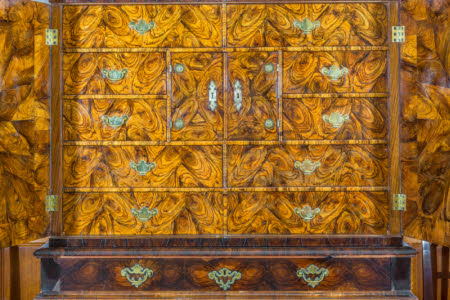
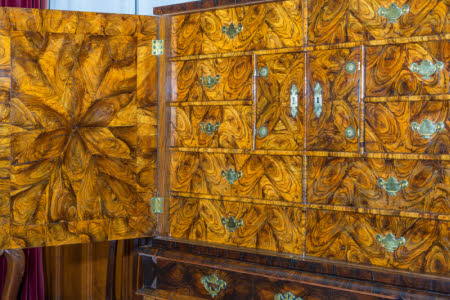
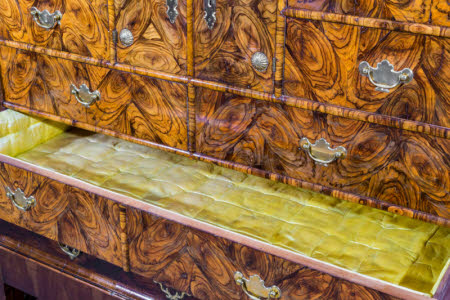
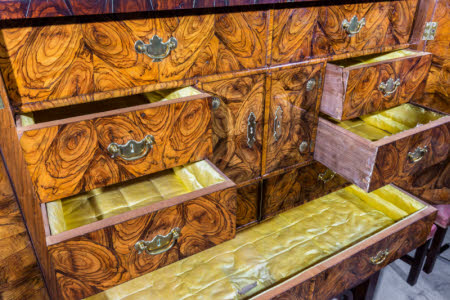
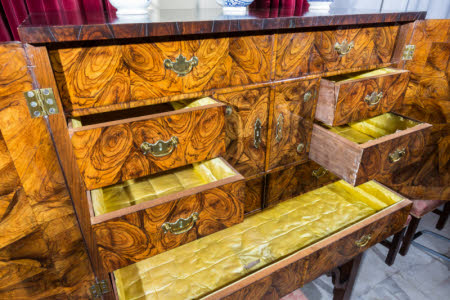
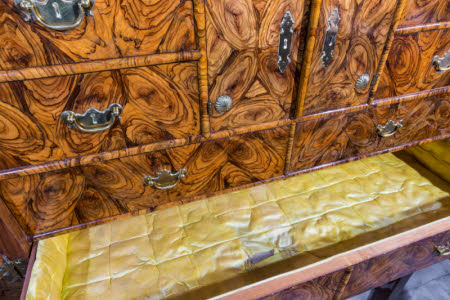
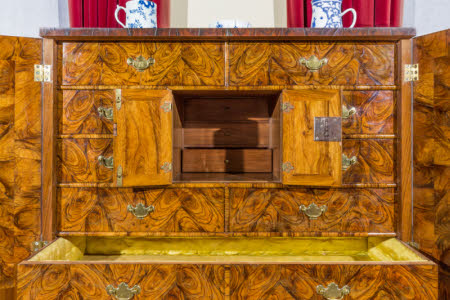
This cabinet is possibly 'a walnut tree cabinet of Gumleys' bought by Ashe Windham for £10 in 1735. The decoration is even more vibrant inside where some of the drawers are lined with yellow silk to keep treasures safe.
Summary
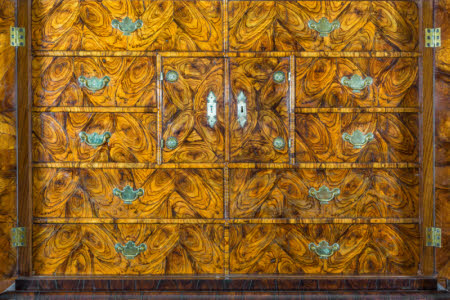
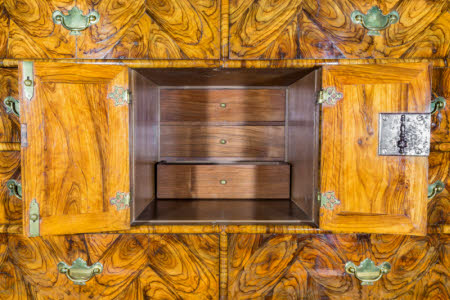
Olive wood and walnut cabinet on later stand, the cabinet probably French circa 1700, the stand English, 19th century. Possibly supplied by Elizabeth Gumley in 1735. The cabinet has a pair of cupboard doors with brass mounts which enclose an arrangement of ten drawers positioned around a cupboard door which then encloses three further small drawers. There is a single frieze drawer below the cupboard and the whole is raised on a later stand with square section legs and corner brackets or spandrels.The drawers are mostly padded and lined with silk
Full description
Cocus wood is a hard wood from the Caribbean which was used by both French and English cabinet makers during the latter part of the 17th century. The possible attribution to France is based on the use of solid walnut for the drawer linings and also the placement of the handles. Although the present handles are later additions the original holes are set to the centre of each of the drawers rather than towards the top as was more common on English examples. Possibly 'A walnut tree cabinet of Gumleys' bought by Ashe Windham for £10 in 1735. For a similar cabinet in form and style see Powis Castle (NT1180814) see also Bowett, Adam 'English furniture 1660-1714' pg.42 pl.2:10 (James Weedon 2017) Notes from Adam Bowett, 2025: An English cabinet dated to 1660-1680. Brassware, catches, locks etc are English with later mid-18th drawer pulls. Primary veneer of olive wood, cut 'oyster' fashion with walnut drawer linings which is uncommon but not unheard of in a quality piece. Original longer drawer below the cabinet with later drawer pulls will have visible original fixing points for the legs underneath. Examples of the silk lining can be found elsewhere, one example is William II's 'box-table' in the closet at Hampton Court. Most silk does not survive but surviving examples show red, pink and green silk. Felbriggs example is the first I've seen of yellow silk. Typically the silk is padded and mounted on rectangles of card glued to the insides of the drawer. Other extant samples have unquilted linings, with the cloth being glued directly onto the inside of the drawer.
Provenance
Part of the Windham Collection. The hall and contents were bequeathed to the National Trust in 1969 by Robert Wyndham Ketton-Cremer (1906-1969).
References
Bowett 2002: Adam Bowett, English Furniture 1660-1714, 2002, pg.42