Vase
Sèvres Porcelain Manufactory
Category
Ceramics
Date
1774
Materials
Gilt, Hard paste porcelain
Measurements
187 x 242 x 176 mm
Place of origin
France
Order this imageCollection
Uppark House and Garden, West Sussex
NT 137424.1
Summary
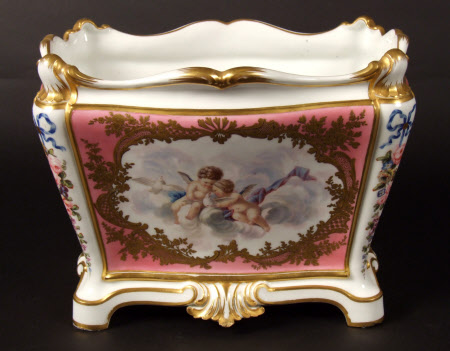
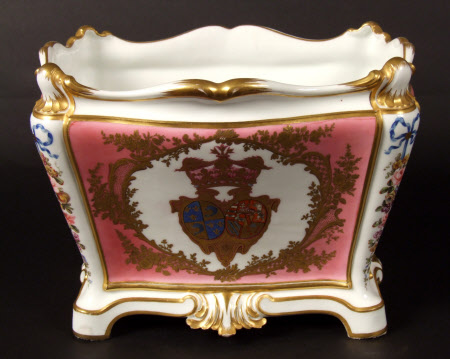
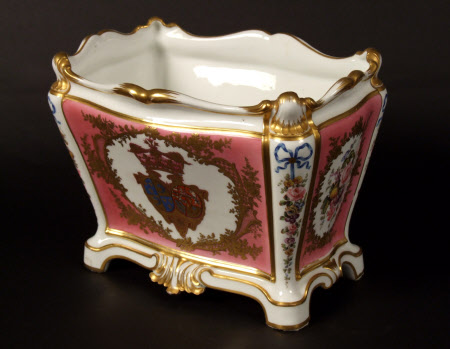
One of three vases or cuvettes à fleur à tombeau, hard-paste porcelain, bearing the arms of Louis XVI and Marie Antoinette as Dauphin and Dauphine, gilders mark for Vincent, date letter 1774, redecorated with cherubs in panels on a pink ground probably in the London workshop of Edward Homes Baldock (1777-1845) c. 1820-30.
Full description
Three vases or cuvettes à fleur à tombeau, hard-paste porcelain, bearing the arms of Louis XVI and Marie Antoinette as Dauphin and Dauphine, gilders mark for Vincent, date letter 1774, redecorated with cherubsin panels on a pink ground probably in the London workshop of Edward Homes Baldock (1777-1845) c. 1820-30. Sir Harry Fetherstonhaugh (1754-1846), grew up surrounded by fine German, English and Chinese ceramics, and became one of the great English collectors of French porcelain purchasing for the future George IV. He visited Paris during the Peace of Amiens in 1803, and returned when the conflicts in France had ended, in 1819 and 1824. The ceramics specialist Anthony du Boulay (1929-2022), provides a detailed assessment of the French porcelain, which once graced Uppark. ‘Like other rich British landowners of the period, he [Sir Harry Fetherstonhaugh] profited from the sale after the French Revolution of Royal and Aristocratic collections. He had obviously acquired a reputation as a connoisseur and many of his Sèvres vases had their counterparts in those pieces bought by the Prince of Wales, later George IV, which are still in the Royal Collection. While one of the Prince’s other advisers was Lord Yarmouth, later 3rd Marquess of Hertford, whose collection of French furniture and Sèvres porcelain was far larger than Sir Harry’s, most of the Sèvres in the Wallace Collection with counterparts in the Royal Collection was, in fact, bought a generation later by the 4th Marquess of Hertford’.[1] By 1809, almost £20,000 had purportedly been spent on china and furniture, so wrote John Webb, the author of the Inventory and Sketch of Sundry Sèvres Vases &c. now at Uppark, 1859, now in the Victoria and Albert Museum archives. Many of the most admired Sèvres garnitures in the collections of the Louvre, the Getty Museum, the Huntington and other American museums were at one time owned by Sir Harry and displayed at Uppark. Some of these ceramics were 18th century pieces, which for various reasons, damage or fashion, had been later decorated or reassembled in combination with ormolu mounts of fine quality dating to the Restauration, c. 1800-30. As du Boulay points out, already by 1859 scholarship had identified these ‘improved’ objects and therefore, they were not described in detail, nor appraised or offered for sale in 1910-11.[2] However in the early 19th century, when seen collectively, Sir Harry was somewhat indiscriminate, buying some of the finest objects produced by the Sèvres factory alongside many “improved” objects. Faced with a veritable treasure trove of French porcelain in the years following the French Revolution, he acquired second-hand objects, in out-of-date styles, guided by those with a historical or aristocratic provenance often with beau bleu grounds enriched with gilding and bronze mounts, a decidedly English Regency taste.[3] [1] Anthony du Boulay, ‘French Porcelain at Uppark; a re-assessment,’ French Porcelain Society, XV, 1999, p. 11. [2] The first publications on French porcelain was by Alexandre-Théodore Brongniart (1739-1813), Traité des Arts Céramiques ou des Poterie, Paris, 1844. [3] Rowell, Christopher, ‘A Sèvres biscuit centrepiece by Alexandre-Théodore Brongniart restored to Uppark’ Apollo, cxlix, April 1999, pp. 54-7, p. 57. Provenance: Listed in Inventory and Sketch of Sundry Sèvres Vases &c. now at Uppark, 1859 by J Webb (V&A Museum) with a sketch. Comparables: with a cuvette à fleur à tombeau, painted by Morin with cherubs on a rose Pompadour ground, dated 1757 in the Wallace Collection (C204 Publication: Anthony du Boulay, ‘French Porcelain at Uppark; a re-assessment,’ French Porcelain Society, XV, 1999
Marks and inscriptions
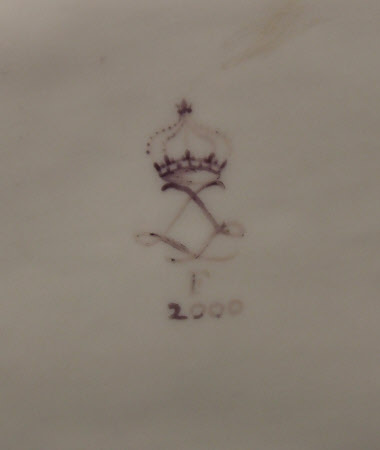
makers mark on base
Makers and roles
Sèvres Porcelain Manufactory , maker Edward Holmes Baldock (1777 - 1845), dealer Henry-François Vincent (1733 - 1809), porcelain maker
References
Boulay, 2000: Anthony du Boulay. “French porcelain at Uppark: a re-assessment.” French Porcelain Society 15 (2000), pp.2-28., p.11