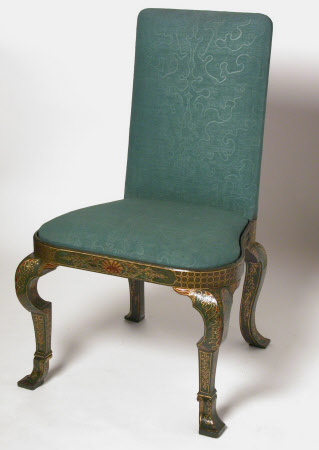
A chair - one of Erddig's 'gold stuff Chairs [and stools] wth green Japan frams' - circa 1720-26
Category
Furniture
Date
circa 1720 - 1726
Materials
Beechwood, green japanned beechwood, gilding, webbing, iron sprigs, worsted
Measurements
98 x 59.4 x 60 cm
Place of origin
London
Order this imageCollection
Erddig, Wrexham
NT 1147122.2
Summary
A chair, one of a set of eight pieces of japanned seat furniture, English, circa 1720-6, possibly made by John Belchier (1717-53), and comprising six chairs and two stools. Having a rectangular back, slightly angled, above a slightly waisted 'compass' seat with a drop-in seat pad. The front legs angular cabrioles, with curved spandrels and pronounced knees. A moulded collar at the ankle, and with square pad feet. The rear legs angular cabrioles. Decorated with green japanning, the Chinoiserie motifs, flowers and foliage and lattice-work, picked out in red and gilt. Made of beechwood, with broad substantial seat rails. Both square and round pegs used in the construction. Some rails still with iron sprigs for fixing loose covers. The back and seat pad upholstered in original blue-green worsted with a meandering line, and with original webbing. This chair with a '1' written in ink to the underside of the seat pad, and chiselled 'III' to rear seat rail.
Full description
This remarkably rare set of six chairs and two stools, all originally green-japanned and covered in gold silk, was made for the Best Bedchamber at Erddig, for which a new bed - hung with embroidered white Chinese silk - had been purchased circa 1720. The bed is believed to have been partly made by John Belchier (1717-53) and so these chairs have also been tentatively attributed to him. However, it should be noted that neither the bed, nor this set of seat furniture, appears on Belchier's surviving bills. The green worsted is also a remarkable survival. Originally, it, in turn, was covered with gold silk, now lost. Some of the beech seat rails still retain their iron sprigs, by which these loose top covers were fixed. According to Adam Bowett, these chairs are the earliest surviving documented chairs with compass seats. The rounded compass seat, with thick rails, allowed for chairs to be made without stretchers. Many of these chairs are numbered to the underside, either in ink or by a mark made with a chisel. Some of these marks may be contemporary with the set's manufacture. Louisa M. Yorke's (1863-1951) Facts and Fanices records that the set as sent for repair to Edward Davies in Chester around 1906. Japanned seat furniture, in imitation of Chinese lacquer, does not survive in great numbers, possibly because the delicate decoration can withstand little use. The pair of stools at Erddig are green, but the Cinoiserie decoration, applied gilt and paint, is now completely gone. NT 1147122.5 has lost the majority of its japanned finish, and has been later covered with woolwoork by Victoria Yorke. NT 1147122.6 has lost both its japanned finish, and its seat pad; its back is covered in ochre velvet or plush. Paint analysis shows that the original finish was formed from a white oil ground, applied to the wood in three coats. The first was white, the second a cream colour, and the third pure white. The green was built up in three or four thin layers based on a mixture of verdigris particles, and a copper green glaze, based presumably on verdigris dissolved in oil. In the final layer there were only a few particles of verdigris, and it was effectively a solid green glaze. The green was followed by a thick coat of clear glaze, or varnish. The red and gold decoration was laid on top of the varnish: first a very thin layer of vermilion was brushed on, and then the gold was laid over the top. (Megan Wheeler, February 2019)
Provenance
Listed in the inventory taken at Erddig in 1726 in the Best Bedchamber and by descent, until given by Philip Yorke III (1905-1978) along with the estate, house and contents to the National Trust in 1973.
Marks and inscriptions
Underside of seat pad: 1 Inside of rear seat rail: III
References
Drury, 1978: Martin Drury. “Early eighteenth-century furniture at Erddig.” Apollo 108 July (1978): pp.46-55., p. 53, Figure 12 Bowett 2009, Early Georgian Furniture 1715 - 1740 (2009), pp.171-2, Plate 4:54