The Dance
William Bradshaw (1700 - 1775)
Category
Tapestries
Date
circa 1734 - circa 1740
Materials
Tapestry, wool and silk, 8 warps per cm
Measurements
2711 mm (H); 5004 mm (W); 2 mm (D)
Order this imageCollection
Ham House, Surrey
NT 1139884.2
Summary
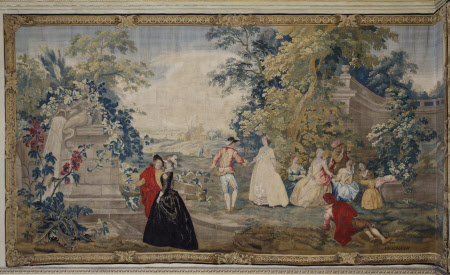
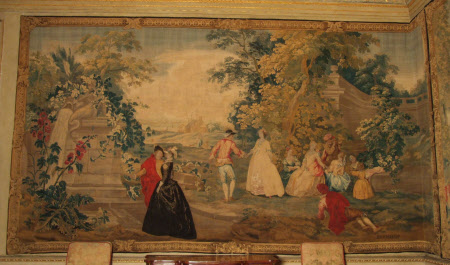
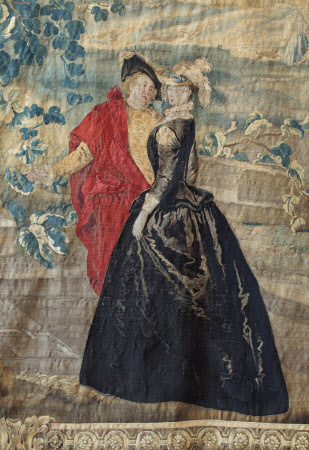
Tapestry, wool and silk, 8 warps per cm, The Dance from a set of four Pastorals, William Bradshaw, London, after Antoine Watteau, Nicolas Lancret and Jean-Baptiste Pater, c. 1734-1740. In the centre of the tapestry a man and a woman dance, an to their right a man plays a flute surrounded by a group of women and girls, a young man reclining on the ground in front of them. In the left foreground a woman in a black dress stands looking out at us with a man in a red jacket. There is a fountain in the form of a dolphin on a high plinth on the left, and a tall stone wall topped with a balustrade on the right. The landscape is framed by trees on either side and extends into the distance in the centre. The borders take the form of a carved and gilded picture frame with scrolling decorations at the corners and at intervals along each side.
Full description
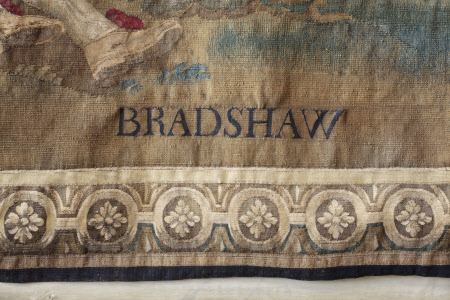
The figures in 'The Dance' are drawn from five different print sources. The couple in the left foreground are after Watteau's 'Le Passe-Temps', engraved by Benoît Audran in 1729; the dancing man is from Lancret's 'Les Agréments de la Campagne', engraved by François Joullain in 1734, and his companion is after Lancret's 'L'Automne' engraved by Nicolas-Henri Tardieu in 1730, whilst the group on the right hand side and the reclining man in the right foreground are all taken from Pater's 'Fête Galante', with the figures rearranged and some of them reversed. The four 'Pastoral' tapestries that hang in the Queen's Bedchamber are not united by any narrative theme, they represent simple countryside pass-times of fruit gathering, dancing, music making and playing on a swing. The designs, although they appear unified, are in fact based on an assemblage of figures taken from different printed sources, all after Antoine Watteau and his two principal followers, Jean-Baptiste Pater and Nicolas Lancret (many of the print sources were identified in MacColl 1917b). The tapestries were designed to appeal to the well-known English taste for paintings by Watteau in the eighteenth century. The tapestries are signed 'BRADSHAW' for William Bradshaw (1700-1775), the foremost tapestry producer in London from the early 1730s to the mid 1750s. Bradshaw had workshops on the corner of Soho Square with back premises extending down the west side of Greek Street, and from here he ran a thriving business as an upholsterer, with tapestry making just one aspect of his activity (Beard, 2002; Sheppard, 1966; Wyld, forthcoming). From the late 1730s until the mid 1750s Bradshaw worked for the 4th Earl of Dysart at Ham House, and his work included fitting out the Queen's Bedchamber where the 'Pastoral' tapestries hang. The 'Pastoral' tapestries were installed at Ham in April 1742. They had in fact been made for another of Bradshaw's clients, Henry O'Brien, 8th Earl Thomond (1688-1741) for his house at Shortgrove in Essex. Thomond died suddenly in 1741 and the contents of his houses was sold. Bradshaw was employed to value the furniture, and he attended Thomond's sale and bought a number of items, including the four tapestries for £184. The bill for the tapestries was paid by the Earl of Dysart, and they were altered slightly before being installed in the Queen's Bedchamber at Ham (Wyld, forthcoming b). The 'Pastorals' were Bradshaw's most popular set of tapestry designs. A number of examples, all including a selection of the four scenes at Ham (with small variations in the figures), have surfaced on the art marked in the twentieth century (Franses archive; Marillier tapestry subject archive; Getty Photo Study Collection). Other than the set at Ham the only weavings to remain in their original setting are two suites at Holkham Hall, Norfolk. (Helen Wyld, 2011)
Provenance
Made by William Bradshaw for Henry O'Brien, 8th Earl of Thomond (1688-1741) between 1734 and 1740; on his death sold by his executors and purchased by William Bradshaw on behalf of Lionel Tollemache, 4th Earl of Dysart (1708–1770) and installed at Ham House; thence by descent until acquired in 1948 by HM Government when Sir Lyonel, 4th Bt (1854 – 1952) and Sir Cecil Tollemache, 5th Bt (1886 – 1969) presented Ham House to the National Trust, and entrusted to the care of the Victoria & Albert Museum; returned to the care of the National Trust in 1990, ownership transferred to the National Trust in 2002.
Credit line
Ham House, the Dysart Collection (purchased by H.M. Government in 1948 and transferred to the National Trust in 2002)
Marks and inscriptions
In lower right corner of main field: BRADSHAW
Makers and roles
William Bradshaw (1700 - 1775), workshop after Jean-Antoine Watteau (Valenciennes 1684 - Paris 1721), designer after Nicolas Lancret (Paris 1690 – Paris 1743), designer after Jean-Baptiste Pater (Valenciennes 1695 - Paris 1736) , designer
References
Wyld, 2013 b: Helen Wyld, 'William Bradshaw's Tapestries after Watteau', in Christopher Rowell (ed.), Ham House: 400 Years of Collecting and Patronage, New Haven and London 2013, pp. 325-336 Beard, 2002: Geoffrey Beard, ‘William Bradshaw: furniture maker and tapestry weaver’, Metropolitan Museum Journal, vol. 37, 2002, pp. 167-169 Hefford, 1984: Wendy Hefford, 'Soho and Spitalfields: little-known Huguenot tapestry-weavers in and around London, 1680-1780', Proceedings of the Huguenot Society of London, vol. XXIV, no. 2 (1984), pp. 103-112 MacColl, 1917b: D S MacColl, 'Bradshaw's Tapestries at Ham House', The Burlington Magazine for Connoisseurs, vol. XXXI, no. 175 (October, 1917), pp. 148-57 MacColl, 1917a: D S MacColl, 'Bradshaw's Tapestries: A Note', The Burlington Magazine for Connoisseurs, vol. XXX, No. 171 (June, 1917), pp. 218-219 Sheppard, 1966: 'Appendix I: The Soho Tapestry Makers', in F H W Sheppard (General editor), Survey of London: vols. XXXIV-XXXV, The Parish of St Anne Soho, London 1966, pp. 515-520