Dionysus
workshop of Matthew Brettingham the Younger (1725 - 1803)

Category
Art / Sculpture
Date
circa 1758
Materials
Bronzed plaster
Measurements
495 x 333 x 330 mm
Place of origin
London
Order this imageCollection
Kedleston Hall, Derbyshire
NT 108988.7
Summary
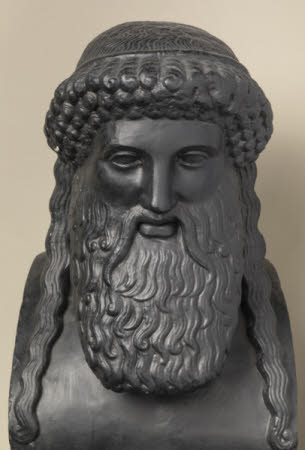
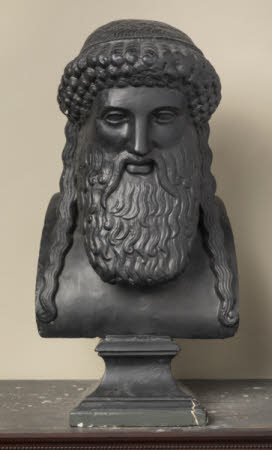
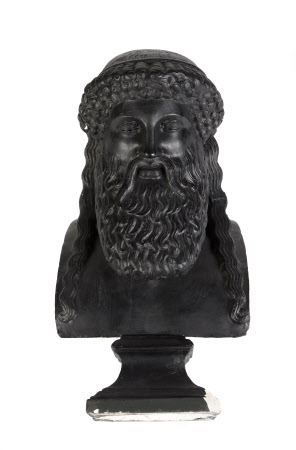
Bronzed plaster, Dionysus, after the antique, probably cast in London, possibly by Bartolomeo Mattevali, on behalf of Matthew Brettingham (1725-1803), c.1758. A bust of Dionysus, the Greek god of wine and revelry, formerly thought to depict Plato. Dionysus wears a filet drawing three rows of tight curls around the forehead; long curls fall down onto the shoulders. A dense, broad beard projects forward. One of set of seven plaster portrait busts depicting Greek and Roman philosophers, writers, gods and goddesses, each cast from moulds after antique busts in Roman collections. Painted to look like bronze, mounted on a socle atop the bookshelves in the Library of Kedleston Hall.The bust is cast after a herm excavated in a vineyard near the Basilica of St John Lateran (San Giovanni in Laterano), Rome, and purchased by Matthew Brettingham (Michaelis 1882, p. 317).
Full description
During his seven-year stint in Rome (1747-54) Matthew Brettingham not only dealt in casts and antiquities - furnishing the Earl of Leicester, for example, with casts and marble statues for Holkham Hall - but also commissioned actual moulds to be taken from famous Roman antiquities. The idea was that casts could then be made to order when he returned to London. He commissioned moulds for sixty busts, divided between Greek and Roman subjects, and twelve moulds of full-size statues. In addition to the 10 casts of statues he purchased for the Marble Hall, Nathaniel Curzon, 1st Baron Scarsdale (1826-1804), bought many of the classical busts on Brettingham’s books. Seven are mounted on top of the bookcases (NT 108611) in the Library of Kedleston Hall, in a display related to Robert Adam’s proposed designs for the room (see NT 109438–109442).The busts depict: the Greek philosopher Socrates; Homer, the legendary Greek author of the Iliad and Odyssey; the Greek goddess Athena; a Vestal Virgin of Rome; the Greek poets Pindar and Sappho; and Dionysus, Greek god of wine and revelry.Brettingham's Rome Account Book, his ledger of statues dealt, casts made, bought and sold when he was in Italy, confirms that the Library busts were moulded from some of the most prestigious antiquarian collections in Rome. The anomaly, however, is the bust of ‘Dionysus’, which in the 18th century was understood to depict the Greek philosopher Plato. The reattribution is owed to Adolf Michaelis, whose survey of antiquities at Holkham Hall included the Roman herm from which the Kedleston Dionysus was cast (Michaelis 1882, p. 317 no. 47). That herm was ‘dug up in a vineyard near the Church of St John Lateran’, bought by Brettingham in 1752, moulded and eventually sold to the Earl of Leicester for Holkham. According to Brettingham’s accounts, a mould for the herm or ‘Erma’ of ‘ye Plato’ was taken in June 1752 (Kenworthy-Browne 1983, pp. 59, 66, 78, 80). The cast was sold to Curzon as ‘Plato’ in 1758. A receipted bill, dated 23 January 1758, exists in the Kedleston Archive for five of the busts: ‘the Farnesian Homer’ for which Brettingham charged Lord Scarsdale £2-0s-0d (just over £200 in today’s money) and the ‘Vestal Virgin’, ‘Pindar’, ‘Socrates’ and ‘Plato’ (i.e. Dionysus) all charged at £1-10s-0d (just over £150). The bust is listed in Nathaniel Curzon’s handwritten ‘List of Statues I have’ (c. 1760; MS, Kedleston Archive) as 'Plato' and, erroneously, as 'Anachreon' (the bearded Greek lyric poet) in the 1769 published ‘Catalogue of the pictures, statues, &c. at Kedleston’ (p. 13). Alice Rylance-WatsonMarch 2019
Provenance
Purchased by Nathaniel Curzon, 1st Baron Scarsdale (17126-1804) in c. 1758; see receipted bill dated 23 January 1758 for five of the busts (Homer, Vestal Virgin, Pindar, Socrates and Plato (i.e. Dionysus), each bust at £1-10-0 (MS, Kedleston Archive); identifiable, although with some incorrect titles, in the 1769 'Catalogue of the pictures, statues, &c. at Kedleston' (p. 13) as 'Busts of Homer, Sappho, Socrates, Virgil (incorrect), Anacreon (incorrect), Pindar, Horace (incorrect); identifiable in the 1861 'Catalogue' (p. 13), the busts listed as exactly as they were in 1769; purchased with part of the contents of Kedleston Hall with the aid of the National Heritage Memorial Fund in 1986 when the house and park were given to the National Trust by Francis Curzon, 3rd Viscount Scarsdale (1924-2000).
Credit line
Kedleston Hall, The Scarsdale Collection (acquired with the help of the National Heritage Memorial Fund and transferred to The National Trust in 1987)
Makers and roles
workshop of Matthew Brettingham the Younger (1725 - 1803), dealer
References
Kenworthy-Browne 1983: John Kenworthy-Browne, 'Matthew Brettingham's Rome Account Book 1747-1754', The Volume of the Walpole Society, vol.49 (1983), pp.37-132 Michaelis 1882: Adolf Michaelis, Ancient Marbles in Great Britain described by Adolf Michaelis, Cambridge 1882 Kenworthy-Browne 1993: John Kenworthy-Browne, ‘Designing around the statues. Matthew Brettingham’s casts at Kedleston’, Apollo, April 1993, pp.248-252