A running athlete, from Herculaneum
Sabatino de Angelis (b.1838)
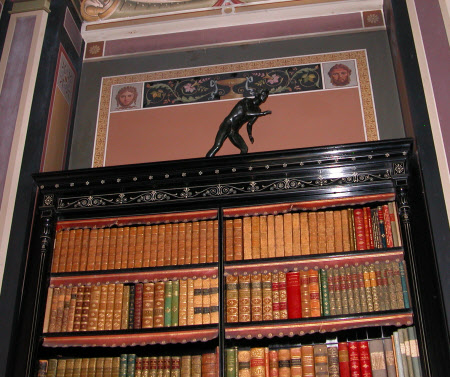
Category
Art / Sculpture
Date
c. 1880 - 1900
Materials
Bronze
Measurements
445 x 270 x 122 mm
Place of origin
Naples
Order this imageCollection
Ickworth, Suffolk
NT 850845.1
Summary
Sculpture, bronze; a running athlete; Naples, Sabatino de Angelis foundry, after an antique bronze figure; c. 1880-1900. One from a pair of near identical figures of running athletes, reductions of bronze figures discovered in the Villa dei Papiri in the Roman town of Herculaneum, buried by the eruption of Vesuvius in A.D. 79. The first discoveries from the cities buried under ash from the volcano were made at Herculaneum in the mid-eighteenth century, including the figures of the running athletes, brought to light in 1754. The pair of bronzes at Ickworth, reduced size copies of the originals, were cast in the foundry of Sabatino de Angelis. He was one of the best of a number of Neapolitan sculptors in the later nineteenth and early twentieth centuries, who set up bronze foundries to meet the demand for copies of famous antiquities, especially but not only those discovered in Pompeii and Herculaneum. The two runners must have been acquired in order to furnish the Pompeian Room in the West Corridor at Ickworth, completed in 1879.
Full description
A figure of a running athlete, a reduction of one of a pair of bronze statues from Herculaneum. In each the young man is depicted naked and bent forward, with his weight on his left leg, his right hand partly raised, left arm and hand by his side. Both men have vigorously curled hair and partly-silvered eyes. Mounted on a separately cast rectangular bronze base, which is stamped ‘Fonderia Artistica, Sabatino de Angelis et Fils, Napoli.’ Pair to 850845.2. The figures are small reproductions of a pair of all but identical medium-sized bronze figures that were discovered at Herculaneum in July 1754, in a room of the so-called Villa dei Papiri. The figures are known as the ‘Statues of the Runners’ (‘Statue di corridori’) and seem to depict athletes engaged in a race. The original bronze figures, which have eyes made from stone and bone inlays, are today in the Museo Archeologico Nazionale in Naples (Invs. 5626-27; Lapatin 2019, pp. 170-71, nos. 18-19). They are Roman copies of a lost Hellenic sculpture from the fourth or third century B.C., which perhaps depicted a victor in the celebrated Panhellenic Games. The runners were standard items in the catalogues of the main Naples foundries. They appear in the 1900 Sabatino de Angelis catalogue and then in the catalogue published in 1910 for the combined Chiurazzi and De Angelis foundries. Both catalogues offered the models in the original size, 118 cms. high, and in three smaller sizes, 54, 46 and 27 cms., and in two patinations, ‘Herculaneum’ and ‘Modern’. The Ickworth figures, which are the 46 cm. size, would seem to have been given the darker ‘Herculaneum’ patination. They must have been acquired in order to furnish the Pompeian Room in the West Corridor at Ickworth, completed in 1879. The Runners have continued to this day to be greatly admired by visitors to the Museo Nazionale in Naples. In a memorable scene in Roberto Rossellini’s 1954 film Viaggio in Italia, Ingrid Bergmann finds herself intrigued by these remarkable sculptures (Lapatin 2019, p. 3. Fig. 1.3). Jeremy Warren July 2025
Provenance
Part of the Bristol Collection. Acquired by the National Trust in 1956 under the auspices of the National Land Fund, later the National Heritage Memorial Fund.
Marks and inscriptions
In cartouche on base:: Fonderia Artistica / Sabatino de Angelis et Fils / Napoli 'Londeria Artistica, Tuio de Angelis [ampersand] Fils, Napoli'
Makers and roles
Sabatino de Angelis (b.1838) , sculptor De Angelis and Son (Naples 1840 - 1915), founder
References
Sabatino 1900: Catalogue illustré de Sab. De Angelis et fils, Naples, Naples 1900, pp. 30-31, nos. 5626-27. Chiurazzi and De Angelis 1910: Fonderie Artistiche Riunite. J. Chiurazzi & Fils – S. De Angelis & Fils. Bronzes, Marbres, Argenterie, Naples 1910, pp. 72-73, nos. 5626 & 5627. Lapatin 2019 : Kenneth Lapatin, ed., Buried by Vesuvius. The Villa dei Papiri at Herculaneum, exh. cat., J. Paul Getty Museum, Los Angeles 2019.