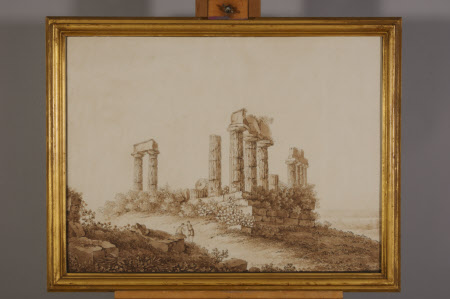
The Temple of Juno and Lucia at Girgenti (Agrigento)
Franz Kaisermann (Yverdon 1765 - Rome 1833)
Category
Art / Drawings and watercolours
Date
Unknown
Materials
Glass, Paper, Wood
Measurements
482 x 647 mm
Order this imageCollection
Florence Court, County Fermanagh
NT 630543
Summary
Black chalk, pen and brown ink and brown wash on paper, The Temple of Juno and Lucia at Girgenti (Agrigento) by Franz Kaisermann (Yvrdon 1765 – Rome 1833). Signed and inscribed Keiserman fecit Roma, lower right. The viewpoint corresponds with that of J P Hackeerts Veduce Della Sicilia pl.1. The viewpoint corresponds with that of J.P. Hackert’s Vedute della Sicilia, pl.1. The temple had earlier been sketched in watercolour from a different viewpoint, facing the last four columns on the right, by Keiserman’s teacher, Ducros, when he accompanied three Dutchmen and an Englishman on a tour of South Italy, Sicily, and Malta, in 1778 (c.f. Reisjournaal in aquarel / A Tour in Words and Watercolour, ed. J.W. Niemeijer, Rijksprentenkabinett, Amsterdam, 1986, no.43). Agrigentum was a Greek colony on the southern coast of Sicily, renowned for its wealth and luxurious living. It was celebrated for its temples of Jupiter and Hercules, and for the best-preserved temple, the Temple of Concord (an undated sepia drawing of which by Keiserman was auctioned at Christie’s, New York, 25 January, 2002, lot 151). Lucina is variously thought to have been an independent goddess, a daughter of Jupiter and Juno, who was invoked by women in childbirth; or as an appellation of Juno herself, as in the temple at Rome named after her.
Provenance
Purchased by the National Trust at auction with the assistance of a grant from the Art Fund, 1999.
Makers and roles
Franz Kaisermann (Yverdon 1765 - Rome 1833), artist