Secrétaire
manner of François-Honoré-Georges Jacob-Desmalter (1770 - 1841)
Category
Furniture
Date
circa 1810
Materials
Mahogany, ormolu, oak, mirrored glass, ebony
Measurements
143.1 x 96.1 x 43.1 cm
Place of origin
Paris
Order this imageCollection
Anglesey Abbey, Cambridgeshire
NT 514481
Summary
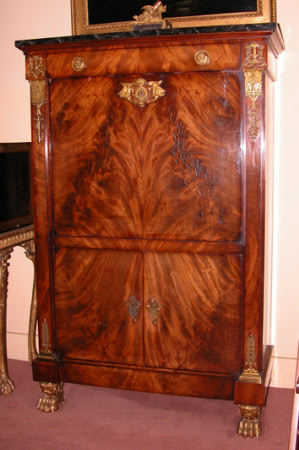
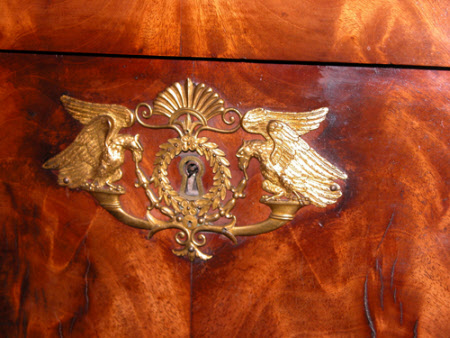
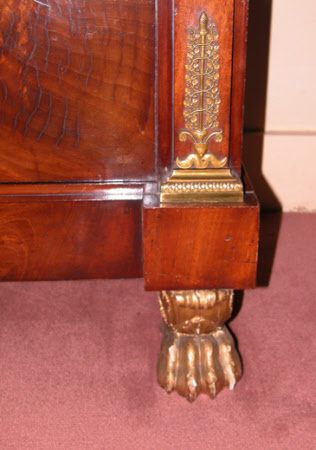
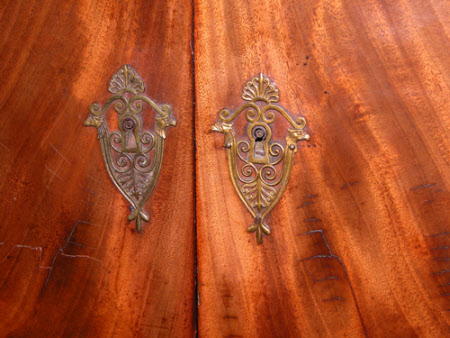
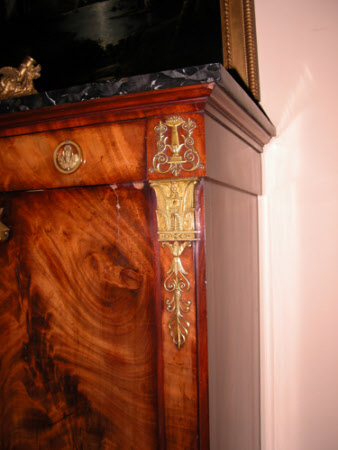
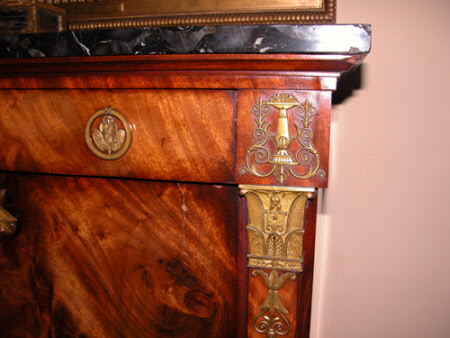
A mahogany and ormolu mounted secretaire a abattant, in the manner of Jacob Desmalter (1770–1841), Paris, circa 1815 the mounts in the manner of Pierre-Phillipe Thomire (1751–1843) Originally with a marble top above a frieze drawer and a fall with leather-lined writing surface and enclosing a mirrored architectural interior incorporating various drawers, the lower section with a pair of cupboard doors enclosing three drawers and raised on giltwood paw feet. The whole mounted with ormolu plaques in the form of lotus and anthemion, classical female figures and eagles.
Full description
François-Honoré-Georges Jacob-Desmalter (1770–1841) oversaw one of the most successful and influential furniture workshops in Paris, from 1796 to 1825. The son of Georges Jacob an outstanding chairmaker who worked in the Louis XVI and Directoire styles of the earlier phase of Neoclassicism and executed many royal commissions, Jacob-Desmalter, in partnership with his older brother, assumed the family workshop in 1796. Freed from the Parisian guild restrictions of the Ancien Régime, the workshop was now able to produce veneered case-pieces (ébénisterie) in addition to turned and carved seat furniture (menuiserie). When his brother died, Jacob-Desmalter drew his father from retirement and began to develop one of the largest furniture workshops in Napoleonic Paris. Furniture in the Empire style produced by the firm of Jacob-Desmalter et Cie in rue Meslée, Paris, mainly used mahogany veneers with gilt-bronze mounts. Seat furniture forms, of mahogany when they were not painted or gilded, derived inspiration from seats and thrones of Antiquity, recognizable in details from bas-reliefs and on Greek vases. Jacob-Desmalter, principal supplier of furniture to the Emperor, also received commissions from Pauline Borghese, Napoleon's sister in Rome, and the Empresses Joséphine and Marie Louise, for whom he supplied numerous pieces for the Château de Malmaison, the Château de Compiegne and other imperial residences. Important commissions included a magnificent cradle built for the infant King of Rome, and the most expensive single item, the jewel cabinet for the Empress, delivered in 1809 for the Empress Joséphine's state bedroom in the Tuileries (soon to be used by Marie-Louise). It was designed by the architect Charles Percier and embellished with gilt-bronze plaques: the central one, according to its original description, depicts the "Birth of the Queen of the Earth, to whom Cupids and Goddesses hasten with their Offerings" by the Empire's most eminent bronzier, Pierre-Philippe Thomire, modelled by Antoine-Denis Chaudet Pierre-Philippe Thomire (1751–1843) a French sculptor, was the most prominent bronzier, or producer of ornamental patinated and gilt-bronze objects and furniture mounts of the First French Empire. His fashionable neoclassical and Empire style furnishing bronzes (bronzes d'ameublement) established the highest standard of fondeur-ciseleur (founder-finisher). He was trained in the workshop of Pierre Gouthière, the outstanding Parisian gilder working in the Louis XVI style, before establishing his own shop in 1776. He gradually assumed the leading position of his former master. Denise Ledoux-Lebard, 1965. Les ébénistes Parisiens du dix-neuvième siècle James Weedon (October 2017)
Provenance
Bequeathed to the National Trust by Huttleston Rogers Broughton, 1st Lord Fairhaven (1896-1966) with the house and the rest of the contents.
Makers and roles
manner of François-Honoré-Georges Jacob-Desmalter (1770 - 1841), furniture maker manner of Pierre-Philippe Thomire (Paris 1751 – Paris 1843), bronze caster