You searched for parts within a set, National Trust Inventory Number: “33238

Show me:
and
Clear all filters

  • Explore
  • Explore
  • Explore
  • Explore
  • Explore
  • Explore
  • Explore
  • Explore
  • Explore
  • Explore
  • Explore
  • Explore
  • Explore
  • Explore
  • Explore
  • Explore
  • Explore
  • Explore
  • Explore
  • Explore
  • Explore
  • Explore
  • Explore
  • Explore
  • Explore
  • Explore
  • Explore
  • Explore
  • Explore
  • Explore
  • Explore
  • Explore
  • Explore
  • Explore
  • Explore
  • Explore
  • Explore
  • Explore
  • Explore
  • Explore
  • Explore
  • Explore
  • Explore
  • Explore
  • Explore
  • Explore
  • Explore
  • Explore
  • Explore
  • Explore
  • Explore
  • Explore
  • Explore
  • Explore
  • Explore
  • Explore
  • Explore
  • Explore
  • Explore
  • Explore
  • Explore
  • Explore
  • Explore
  • Explore
  • Explore
  • Explore
  • Explore
  • Explore
  • Explore
  • Explore
  • Explore
  • Explore
  • Explore
  • Explore
  • Explore
  • Explore
  • Explore
  • Explore
  • Explore
  • Explore
  • Explore
  • Explore
  • Explore
  • Explore
  • Explore
  • Explore
  • Explore
  • Explore
  • Explore
  • Explore
  • Explore
  • Explore
  • Explore
  • Explore
  • Explore
  • Explore
  • Explore
  • Explore
  • Explore
  • Explore
  • Explore
  • Explore
  • Explore
  • Explore
  • Explore
  • Explore
  • Explore
  • Explore
  • Explore
  • Explore
  • Explore
  • Explore
  • Explore
  • Explore
  • Explore
  • Explore
  • Explore
  • Explore
  • Explore
  • Explore
  • Explore
  • Explore
  • Explore
  • Explore
  • Explore
  • Explore
  • Explore
  • Explore
  • Explore
  • Explore
  • Explore
  • Explore
  • Explore
  • Explore
  • Explore
  • Explore
  • Explore
  • Explore
  • Explore
  • Explore
  • Explore
  • Explore
  • Explore
  • Explore
  • Explore
  • Explore
  • Explore
  • Explore
  • Explore
  • Explore
  • Explore
  • Explore
  • Explore
  • Explore
  • Explore
  • Explore
  • Explore
  • Explore
  • Explore
  • Explore
  • Explore
  • Explore
  • Explore
  • Explore
  • Explore
  • Explore
  • Explore
  • Explore
  • Explore
  • Explore
  • Explore
  • Explore
  • Explore
  • 2 items Explore
  • Explore
  • Explore
  • Explore
  • Explore
  • Explore
  • Explore
  • Explore
  • Explore
  • Explore
  • Explore
  • Explore
  • Explore
  • Explore
  • Explore

Select a time period

Or choose a specific year

Clear all filters

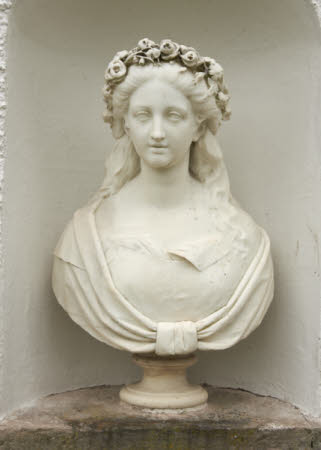
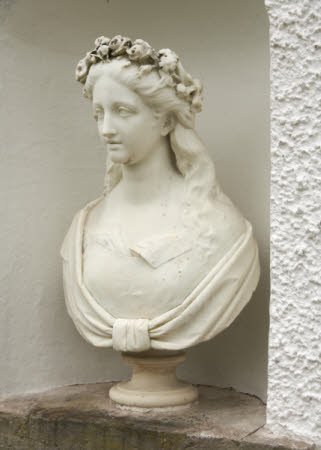
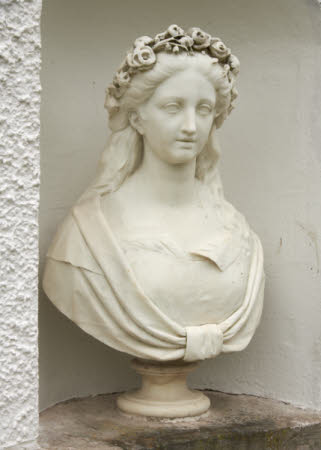
Allegory of Summer, a bust portrait of a young woman.

Roy Coles
Category

Art / Sculpture

Date

c. 1780 - 1820

Materials

Marble on marble socle

Measurements

711 mm high

Place of origin

Italy

Order this image

Collection

Ardress House, County Armagh

NT 247725.3

Summary

Sculpture, marble; Portrait bust of a young woman, with flowers in her hair, an allegory of Summer; Italian, c. 1780-1820. Displayed at Ardress as ‘Summer’ within a group of four heads depicting the Seasons.

Full description

A marble head of a young woman, her head turned slightly to her right, her hair drawn back at the temple and sides of the head, and cascading loosely at the back and over the shoulders. In her hair, she has a wreath formed of roses. She wears a dress and under this a shift, one collar of which is turned over, and over the dress a loose cloak, tied at the centre. Mounted on a turned white marble socle. The sculpture is one of four busts of females at Ardress (NT 247725.1-4) set in niches on the Garden Front of the house, which was redesigned by the second George Ensor (1772-1845). He may be presumed to have acquired the busts and to have installed them as part of the remodelling, but it is not known when and from where they came into his possession. They have long been presented as allegories of the Seasons: Spring, Summer, Autumn and Winter, and all four have hitherto been attributed to Christopher Hewetson, although in fact only the sculpture described as ‘Spring’, a portrait of an unknown woman (NT 247725.4), is signed by him. Whereas of the other three works, two (NT 247725.1-2) are copies after well-known antique models, this bust appears to be wholly modern, and possibly later than the other sculptures in what is in fact a composite group. With her wreath of flowers, the young woman is perhaps intended to represent the goddess Flora. Jeremy Warren June 2022

Provenance

Presumably acquired by George Ensor (1772-1845).

Marks and inscriptions

Number 1 signed on back Christopher Hewitson Fecit

Makers and roles

Roy Coles, sculptor Christopher Hewetson (Thomastown c. 1736 - Rome 1798), sculptor

References

Suárez Huerta 2014: Ana María Suárez Huerta, ‘Will and Inventory of Christopher Hewetson (c1737–1798)’, The British Art Journal, 15, no. 2 (2014), pp. 3-17, p. 7.

View more details