Bernard Shaw: The Platform Spellbinder
Bertha Newcombe (1857 - 1947)
Category
Art / Prints
Date
1893
Materials
woodburytype print
Order this imageCollection
Shaw's Corner, Hertfordshire
NT 1274697
Summary
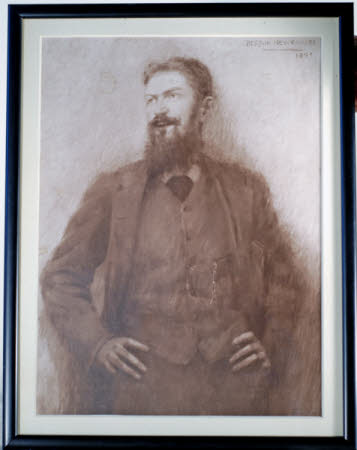
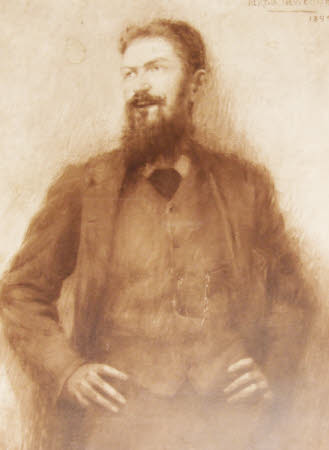
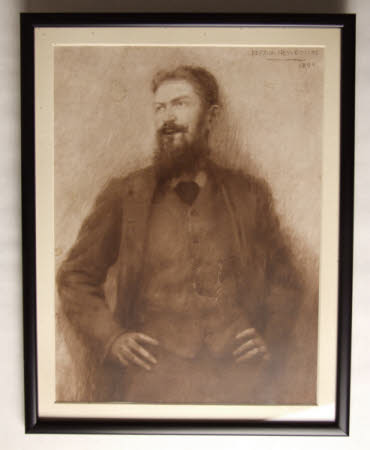
Portrait of Bernard Shaw: a woodburytype print after the original oil painting by Bertha Newcombe (1857-1947) of 1892. The original is signed and dated 1892, however this print is dated 1893. The portrait was given the title “The Platform Spellbinder” by Shaw himself.
Full description
Portrait of Bernard Shaw: a woodburytype print after the original oil painting by Bertha Newcombe (1857-1947) of 1892. The original is signed and dated 1892, however this print is dated 1893. The portrait was given the title “The Platform Spellbinder” by Shaw himself. Three-quarter length portrait (the oil painting provides a more complete view). Shaw stands with his hands on his hips, and his mouth is open suggesting he is a speaking to an audience. He wears a three-piece woollen suit, and a watch chain hangs from his waistcoat. The print is framed and mounted, in an off-white card mount, with a black wood frame. The original oil painting is framed, and measures approximately 5 ft x 3ft 2 inches. The date of the sitting was 1892. According to Shaw’s diary the sittings began on 16 February 1892 at Newcombe’s Chelsea studio, and continued to 31 March 1892. The painting was then exhibited in April 1892 at the New English Art Club in London. Bertha Newcombe’s portrait depicts Shaw in his role as an orator, addressing an audience at a socialist meeting during the early 1890s. Shaw reproduced the portrait in his autobiographical work Sixteen Self-Sketches, with the caption: “G.B.S., Platform Spellbinder, Portrait by Bertha Newcombe, spellbound.” Newcombe was in love with Shaw for several years, but the feeling was not reciprocated. She was acquainted with Beatrice Webb through the Fabian Society, and Beatrice recorded in her diary: “You are well out of it, Miss Newcombe…If you had married Shaw he would not have remained faithful to you.” Newcombe painted a number of watercolours of the socialists at this time, including a post-lecture discussion in the coach house at Kelmscott House; these were published, together with her painting of Shaw in an article by Alice Stronach, ‘Socialist Leaders of To-Day’, (The Windsor Magazine, 1896, pp. 613-625). "The Platform Spellbinder" was reproduced on page 623 with the caption: “Mr. George Bernard Shaw’s attitude towards an audience.” Newcombe became a full-time illustrator for publishers of magazines and novels, and later campaigned for the suffragist movement in various capacities. Shaw was fond of the portrait, and wrote to the actress Molly Tompkins (with whom he was having an affair) in 1927: “you can’t paint half as well as Bertha Newcombe, whose portrait of me open-mouthed on the platform is still the best vision of me at that period.” Shaw chose to reproduce the image in his autobiographical publications Bernard Shaw through the Camera (1948), and Sixteen Self Sketches (1949). The Shaw’s Corner copy is a ‘woodburytype’ print, a photomechanical process much admired by Shaw, developed to create high quality images. When Shaw’s biographer Hesketh Pearson asked him for a copy of Newcombe’s work many years later, he replied: ‘the picture hangs at full length in the Labour Club. But I have an excellent Woodburytype of it which I can get reproduced if the painter consents.’ (Shaw to Pearson, 13 February 1940). The ‘picture’ Shaw refers to here was the original oil painting, which was recently rediscovered, having been presumed lost since the Second World War. In 2012 Professor Audrey Mullender, Principal of Ruskin College, Oxford, noticed the painting in a common room in the college, and contacted a member of the International Shaw Society. It was confirmed as the ‘lost’ work by Newcombe. The painting had originally belonged to the Labour Party, and was returned to their headquarters in London in 2012. Newcombe made sketches of Shaw on other occasions, notably when she accompanied Shaw, the Webbs and Graham Wallas on a visit to Henry Salt’s farmhouse (Borough Farm, Milford, Surrey). Newcombe’s watercolour drawing became known as "The Borough Farm Quartet, August 1894", and it was later used by Shaw as the frontispiece to Edward Pease’s History of the Fabian Society (1916); (see NT 3063052). The drawing had originally been published in The Sketch magazine in July 1895 with the heading ‘The Extreme Left’. A further oil painting of Shaw by Newcombe was painted in 1894 outdoors whilst Shaw was writing his play The Man of Destiny. His diary records the sitting: “we walked to Balcombe through the woods. After dinner we went out and sat on a bank all the afternoon, I reading the play.” Shaw is depicted lying in a field with his pen and notebook. The painting is now owned by the Harry Ransom Center, University of Texas at Austin. It was reproduced in black and white in Archibald Henderson, Bernard Shaw: Playboy and Prophet, 1932 (next to p.212). Henderson gives the painting the title: “The Dramatist in the Throes of Creation”. Shaw himself referred to it as “The Snake in the Grass”. (Alice McEwan, 2020)
Provenance
The Shaw Collection. The house and contents were bequeathed to the National Trust by George Bernard Shaw in 1950, together with Shaw's photographic archive.
Marks and inscriptions
Bertha Newcombe 1893
Makers and roles
Bertha Newcombe (1857 - 1947), portrait painter
References
Bernard Shaw through the camera : 1948., p.29