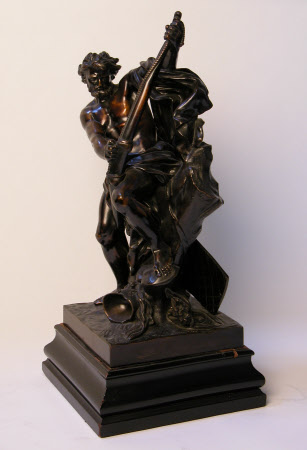
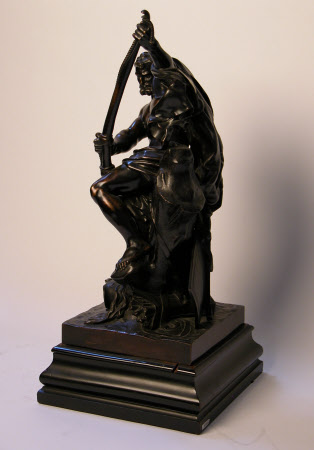
Figure of a soldier bending his bow
after Jacques Bousseau (Chavagnes-en-Paillers, France 1681 - Valsain, Spain 1740)
Category
Art / Sculpture
Date
c. 1840 - 1900
Materials
Bronze and wood
Measurements
432 x 150 x 150 mm (17 x 6 x 6 in )
Place of origin
Paris
Order this imageCollection
Hatchlands Park, Surrey
NT 1166750
Summary
Sculpture, bronze; a Soldier bending his bow; French, after Jacques Bousseau (1681-1740); c. 1820-1900. A bronze cast after the marble sculpture by the French sculptor Jacques Bousseau, submitted in 1715 as the artist’s reception piece presented on his election to the French Royal Academy. The work was popular, with numerous reductions in bronze being made, especially during the nineteenth century.
Full description
A bronze statuette depicting a soldier bending his bow. Naked except for a swag of drapery over his left arm, the man is seated on a tree trunk, his left leg raised and the foot resting on a stump. He grasps a long wooden bow, which he strains to bend to allow it to be strung for use. On the ground before him is his plumed helmet whilst, piled against the tree stump at the back, are his square shield, his sword within its sheath and a quiver of arrows. The main figure was cast separately from the tree stump and the rectangular terrasse, which is textured to indicate the ground. The bronze is a golden colour where the black patination has worn off. On the top surface of the terrasse to the right, between the helmet and the quiver, is the signature, ‘J. Bousseau 1715’. The stamped number ‘2786’ at back, at base of the tree stump. Mounted on a simple ebonised wooden base. A pupil of the sculptor Nicolas Coustou (1658-1733), Jacques Bousseau won the prestigious Prix de Rome in 1705, whilst in 1715 he was elected to the Académie Royale. Bousseau’s reception piece (morceau de réception), the marble sculpture of a soldier bending his bow, is today in the Musée du Louvre, Paris. The subject was suggested to Bousseau by the Academy’s then director, the sculptor Corneille van Clève. The success of the piece led to multiple subsequent attempts to identify its subject. As well as the soldier bending his bow, it has at times been suggested that the figure represents Ulysses (Odyssseus), preparing to shoot with his bow as he returned home to find a host of suitors clustered around his wife Penelope, or alternatively a soldier preparing to fire an arrow into the martyr saint Sebastian. A large number of bronze reductions of the composition survive, all or the great majority of which were made in the nineteenth century. As was usual with the products of the Parisian foundries, the bronze casts seem to have been offered in a range of three sizes, the largest of which are close to the size of the marble original (c. 89 cms.) and are well-modelled and finished; these include examples in the Museum of Fine Arts, Boston (Inv. 62.668) and the Ford Collection, London. Slightly smaller casts, around 65 cms. high, include examples in the National Gallery of Art, Washington D.C. (Inv. 2014.136.248, Corcoran Collection), the Chrysler Museum of Art, Norfolk VA (Inv. 69.34.1), Birmingham Museum and Art Gallery (Silber 1987, no. 28) and Harlow Playhouse. The Hatchlands cast, at a height of just over 40 cms., is an exmple of the smallest size offered. Whereas it is signed with Bousseau’s name and the date 1715, referring to the completion of the marble original, the larger example in Harlow is embellished with the purported signature of an earlier and more celebrated French sculptor, Pierre Puget ( 1620-1694). The Hatchlands cast is a routine production, not especially well-finished. It must have been sold as a pair with the statuette after Jacques Bousseau at Hatchlands, depicting a man bending a bow (NT 1166750), since they bear at the back successive stamped numbers. From the point-of-view of the subject, they make a good pair since both statuettes depict an athletic man straining to bend unyielding wood. Jeremy Warren October 2023
Provenance
Given by Harry Stuart Goodhart-Rendel (1887-1959) in 1947
Marks and inscriptions
Base, right:: J. Bousseau 1715 Base, back:: stamped number: 2786
Makers and roles
after Jacques Bousseau (Chavagnes-en-Paillers, France 1681 - Valsain, Spain 1740), sculptor Jacques Bousseau (Chavagnes-en-Paillers, France 1681 - Valsain, Spain 1740), sculptor
References
New York 1968: The French Bronze,1500-1800, M. Knoedler & Co., New York 1968, no. 56 Silber 1987: Evelyn Silber, Sculpture in Birmingham Museum and Art Gallery. A Summary Catalogue, Birmingham 1987, pp. 16-17, no. 28.