Ulysses and the Phaeacians
Pieter van Aelst the younger (fl. 1509 - 1555)

Category
Tapestries
Date
circa 1550 - circa 1565
Materials
Tapestry, wool and silk, 7 warps per cm
Measurements
3480 mm (H); 4420 mm (W)
Place of origin
Brussels
Order this imageCollection
Hardwick Hall, Derbyshire
NT 1129448.7
Summary
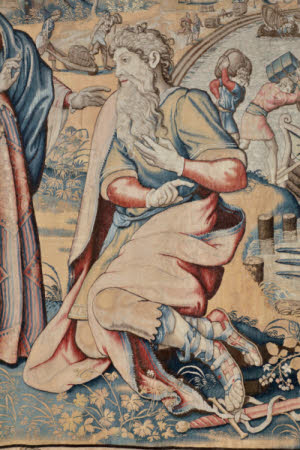
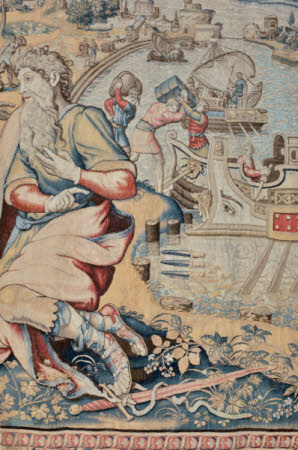
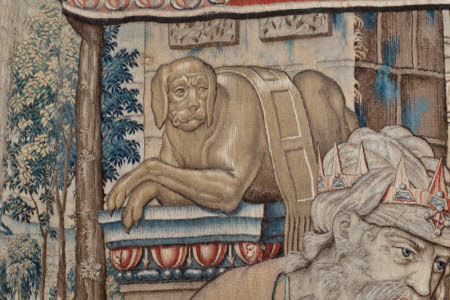
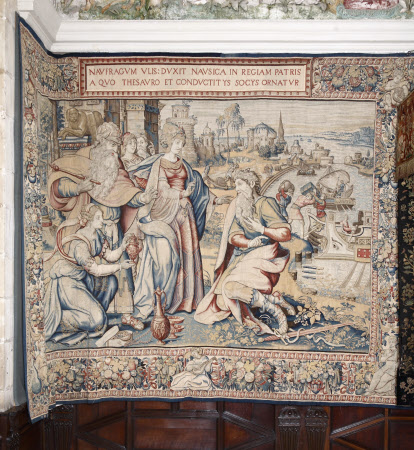
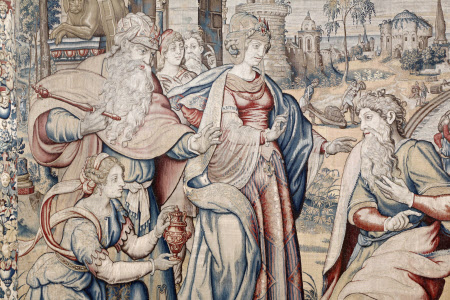
Tapestry, wool and silk, 7 warps per cm, Ulysses and the Phaeacians, from a set of 8 of the Story of Ulysses, Brussels, c. 1550-1565. This is the seventh tapestry in the narrative series. After escaping from Calypso’s island on a raft, Ulysses was shipwrecked and finally washed up on the shore of the land of the Phaeacians. Nausicaa, the beautiful young daughter of the Phaeacian king and queen, found Ulysses on the sea shore, gave him clothes and directed him to her parents’ palace where he threw himself on the mercy of the King and Queen, Alcinous and Arete. They welcomed him warmly, fed and clothed him, showered him with gifts and promised to escort him home in their ships. In the foreground Ulysses is seen kneeling before Alcinous, Arete, and Nausicca, saying goodbye to them and thanking them for their hospitality. Nausicaa presents him with gifts in golden vessels. In the background on the right is the famed harbour of the Phaeacians, where ships are being loaded with the numerous gifts Ulysses has received. On the left is a tiny scene from the beginning of the story, where Nausicaa and her maids find the naked and exhausted Ulysses washed up on the sea shore, and present him with a purple robe. Many details of the scene follow the account in the Odyssey, including the gold and silver dogs guarding the walls of the palace, the park by the palace entrance, the temple in the distance, and the narrow entrance to the harbour.
Full description
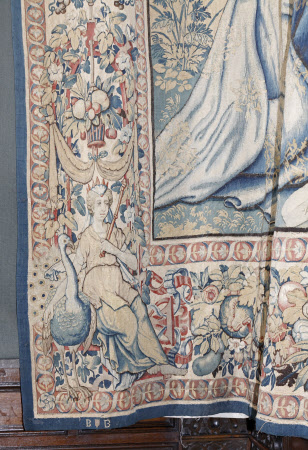
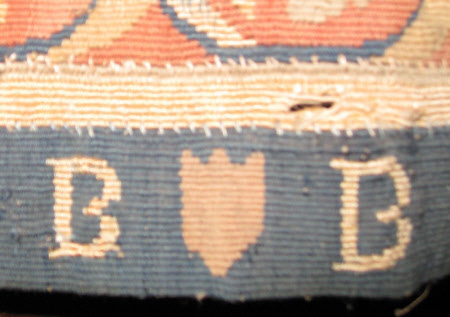
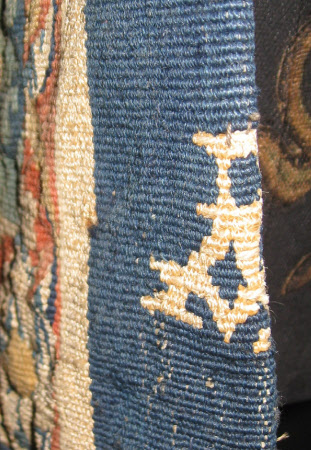
Ulysses arrives in the land of the Phaeacians in Book VI of the Odyssey, and many of his other adventures, including his encounter with Circe and the Sirens, are recounted as part of the story he told to Alcinous and Arete whilst staying in their palace. The eight tapestries at Hardwick tell the story of the classical hero Ulysses (Odysseus in Greek mythology), King of Ithaca. Ulysses was one of the principal champions of the Greek forces during the Trojan Wars as recounted in the ‘Iliad’ of Homer, and he was the hero of Homer’s ‘Odyssey’ which charts his lengthy wanderings again after the war was over before finally returning to Ithaca. Renowned for his resourcefulness and his stratagems, Ulysses was responsible for the famous wooden horse which allowed the Greeks to enter the city of Troy. After the war when the various armies returned home Ulysses and his men were subject to a number of trials and adventures. Eventually Ulysses lost his entire crew, and returned home to Ithaca only after twenty years of wandering. Meanwhile his palace had been beset by suitors for the hand of his beautiful wife Penelope, who feasted continually at the absent king’s expense; on his return Ulysses punished the suitors brutally. The designer of the Ulysses series is unknown but they have been associated on stylistic grounds with Michiel Coxcie (1499-1592) (Roethlisberger 1972), and this is also supported by documentary evidence (Roethlisberger 1972; Delmacel 1993). All eight tapestries bear the mark of the city of Brussels, two Bs either side of a red shield for Brussels and Brabant, in the lower right hand corner. In addition seven of the tapestries also bear one of three different maker’s marks in the lower right corner, and one has signs of a now destroyed mark. The first mark, containing the initials PVA, has most recently been attributed to Pieter van Aelst the younger (fl. 1509-1555) (Delmarcel 1992, p. 440; Delmarcel 1999, p. 363). The second mark, in the form of the letters ‘NH’ with a horizontal line above them, is almost certainly that of Niclaes Hellinck, who is recorded in 1559 and again in 1576 (Delmarcel 1980, p.9; Donnet 1894, p.452; Destrée 1900, pp. 32-33). The third mark, consisting of a vertical line, forked at the top, with three curved horizontal lines crossing it and a circle at the bottom, belongs to an unknown weaver. A similar mark appears on a document dated 1562 accompanied by the signature ‘Niclaes’ (Steppe 1981). The Ulysses tapestries probably date from the 1550s or 1560s. The eight tapestries at Hardwick are the earliest and most complete surviving weaving of a set that was extremely popular during the sixteenth and seventeenth centuries, and numerous different weavings survive. These include a total of fifteen different episodes from the story. The most complete sets are in Schloss Herrnstein, North Rhine-Westphalia, and the Spanish Royal Collection (Junquera de Vega & Gallegos 1986, series 42). The tapestries have been at Hardwick since at least 1601, when they were recorded in an inventory of the house in their present position in the High Great Chamber. There is no record of their purchase, but Santina Levey has suggested that they were the set of hangings mentioned in the legal dispute between Bess and her fourth husband the Earl of Shrewsbury in 1586. One of the items that Shrewsbury claimed ownership of was “Item rich hangings 8 pieces which were Sir William Pickerings and bought by Mr Bateman which cost the Earl £200.” (Levey 1998, pp. 15, 23). Sir William Pickering (1516/17-1575) was English Ambassador to France from 1551-53, and an active patron and collector, with a particular interest in literature. Accused of plotting against Queen Mary’s Spanish marriage in 1553 he narrowly escaped arrest in Paris and spent the following year travelling in Italy and Germany. In December 1554 he was pardoned and in March 1555, a plausible date for the production of the tapestries, he was in Brussels; soon afterwards he was allowed home. Had Pickering wished to purchase or commission a set of tapestries in Brussels the story of Ulysses would certainly have been appropriate, as he was on his way home from an Odyssey in which he had narrowly escaped death. (Helen Wyld, 2009)
Provenance
Woven in Brussels, c. 1550-65; recorded in the inventory of Elizabeth, Countess of Shrewsbury at Hardwick Hall in 1601, hanging in the High Great Chamber; thence by descent to Andrew, 11th Duke of Devonshire; acquired through the National Land Fund in 1956 and transferred to the National Trust in 1959
Credit line
Hardwick Hall, The Devonshire Collection (acquired through the National Land Fund and transferred to The National Trust in 1959)
Marks and inscriptions
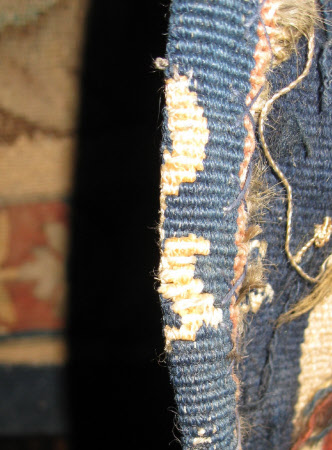
In cartouche in upper border: NAVFRAGVM VLIS: DVXIT NAVSICA IN REGIAM PATRIS / A QVO THESAVRO ET LONDVCTIT YS SOCYS ORNATVR Lower galloon, left: 'BB' either side of a red shield Right hand galloon, bottom: Monogram including the letters 'PVA'
Makers and roles
Pieter van Aelst the younger (fl. 1509 - 1555), tapestry weaver probably Michiel Coxcie the Elder (Mechelen 1499 - Mechelen 1592), artist
References
Delmarcel, 1999: Guy Delmarcel, Flemish Tapestry, Tielt 1999 Levey, 1998: Santina M. Levey, An Elizabethan inheritance: the Hardwick Hall textiles. London: National Trust, 1998. Delmarcel, 1992: Guy Delmarcel, ‘Aelst, Pieter van (d.j.)’, in Gunter Meissner (ed.), Allgemeines Künstlerlexic: die bildend Künstler aller Zeiten und Völker, vol. 1, Munich/Leipzig 1992, p. 440 Junquera de Vega and Gallegos, 1986: Paulina Junquera de Vega and Carmen Díaz Gallegos, Catalogo de Tapices del Patrimonio nacional, volumen II: siglo XVII, Madrid 1986 Steppe 1981 Jan Karel Steppe, ‘Enkele nieuwe gegevens betreffende tapijtwerk van de geschiedenis van Vertumnus en Pomona vervaardigd door Willem de Pannemaker voor Filips II van Spanje’, Artes Textiles, X (1981), pp. 125-140 Delmarcel, 1980: Guy Delmarcel, Tapisseries Anciennes d’Engien, Mons 1980 Roethlisberger 1972 Marcel Roethlisberger, ‘The Ulysses tapestries at Hardwick Hall’, Gazette des Beaux-Arts, vol. 79, 114th year, 6th series, no. 1237 (Feb. 1972), pp. 111-125 Roethlisberger 1971 Marcel Roethlisberger, ‘Deux tentures bruxelloises du milieu du XVIe siècle’, Oud Holland, 1971 pp. 88-115 Destrée 1900 Joseph Destrée, L’industrie de la tapisserie à Enghien et dans la seigneurie de ce nom, Enghien 1900 Donnet, 1894: Fernand Donnet, ‘Les tapisseries de Bruxelles, Enghien et Audenarde pendant la furie Espagnole (1576)’, Annales de la société d’Archéologie de Bruxelles, vol. 8 (1894), pp. 442-476