Tent
Category
Textiles
Date
1725 - 1750
Materials
Cotton chintz, undyed cotton, bamboo, metal and leather
Measurements
2050 mm (H); 1384.5 mm (W)
Place of origin
India
Order this imageCollection
Powis Castle and Garden, Powys
NT 1180731.1
Summary
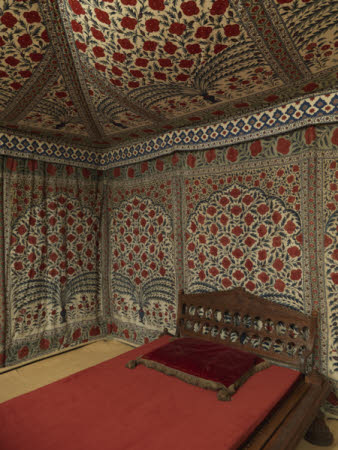
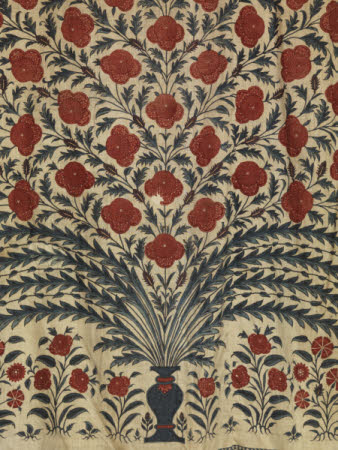
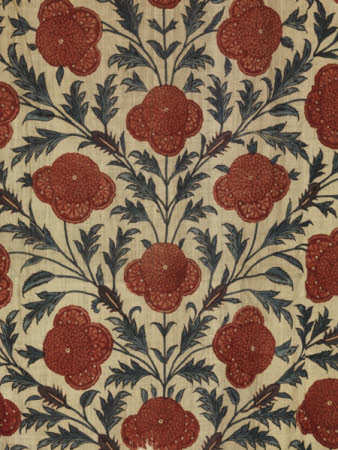
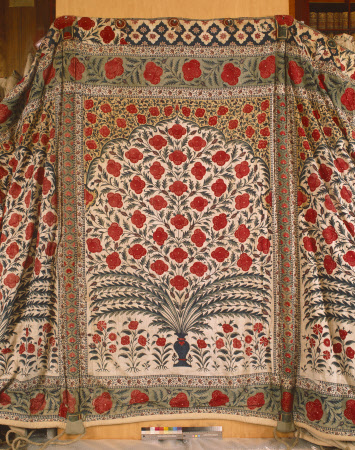
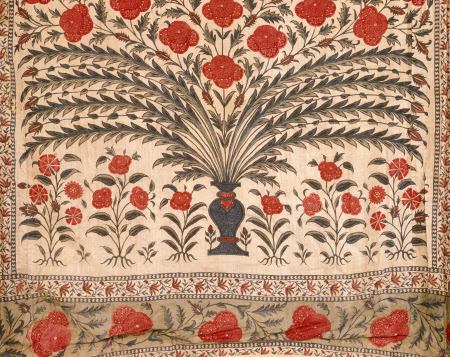
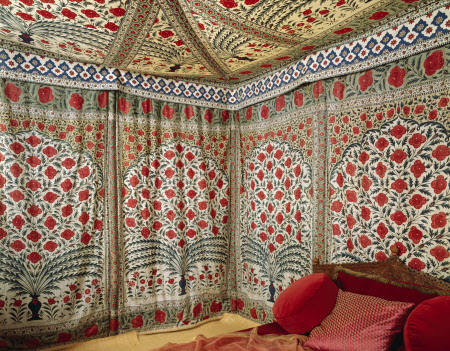
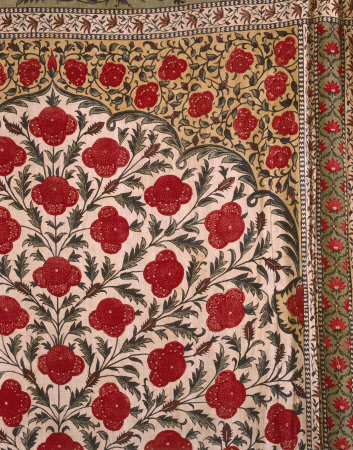
A cotton qanāt (side panel) lined with twelve matching chintz panes, and including thirteen integrated battens, unknown maker, Mughal India, c. 1725-50. This qanāt, and the tent it forms, has long been associated with Tīpū Sultān, the ruler of the South Asian state of Mysuru from 1782-99 (see NT 1180731). The qanāt has three layers, with a plain outer layer and a decorated inner layer on a finer weave cotton. Each of the twelve decorated panes is c. 103cm wide, with vertical and horizontal borders, and separated from the next by a bamboo batten inserted into a vertical pocket. Each pane features a block-printed and painted design of a central vase, branch and flower design on a natural off-white field. This design is very similar as the panes of 1180731.3, though differently proportioned. The fifth pane has been replaced by a taller pane of the same design. This suggests that there was once another tent or qanāt of the same design but different size.
Full description
This 12-paned qanāt formed part of a tent (see NT 1180731) which may have been used by Tīpū Sultān. Tīpū succeeded his father as ruler of Mysuru in 1782, where he built a sophisticated court around his palace at Srirangapatna (formerly known as Seringapatam). High quality painted and printed chintz fabrics were produced at places such as Burhanpur, Machilipatnam and Golconda, and the textiles (c. 1725-50) forming this panel may have originated from one of these sites [Stronge, p. 24]. Similar designs can be seen at the Calico Museum of Textiles, Ahmedabad (No. 222) and the V&A, London (IS 131-1950). Research Note on Provenance: Tīpū Sultān spent much of his reign engaged in the defence of Mysuru against encroachment by the British East India Company. In 1798, a renewed British campaign provoked the Fourth Anglo-Mysore War. On 4th May 1799, during the Siege of Srirangapatna, Tīpū was killed. In the immediate aftermath, the British army looted Srirangapatna. According to Colonel Arthur Wellesley, later the Duke of Wellington, ‘Scarcely a house in the town was left unplundered, and I understand that in camp jewels of the greatest value, bars of gold etc etc have been offered for sale in the bazaars of the army by our soldiers, sepoys and followers. I came in to take command of the army on the morning of the 5th and with the greatest exertion, by hanging, flogging etc etc in the course of that day I restored order…’ [Dalrymple, p. 351] The resumption of control by the higher ranks of the army enabled the work of the prize committee to begin. Prize committees were responsible for ‘collecting, inventorying and disposing of booty seized from the enemy and for compiling detailed lists of who had served under whom in each campaign – thereby seeking to establish combatants’ entitlement to prize' [Finn p. 17]. They were intended to prevent exactly the kind of undisciplined plunder of captured cities and defeated people which Wellesley reported in the aftermath of Tīpū’s defeat at Srirangapatna. More than 1,000 commissioned officers took their allotted share in the captured property, which they kept, exchanged or sold to others. High-value, or high-profile items, were excluded from the prize committee’s remit, and given to senior British civil and military personnel, as well as the British royal family. [1] Not all articles were genuine: tenuous or spurious attributions to Tīpū Sultān have been identified in objects which were brought to Britain. Edward and Henrietta Clive shipped a tent, along with other items formerly belonging to Tīpū Sultān, to Britain in 1801 [Archer p. 29]. The tent was reputedly used at garden parties at Powis, when it was erected with tent pegs made in Britain of local timber. [1] ‘Tipu Sultan’s Amulet Case’, accessed online at https://www.nms.ac.uk/explore-our-collections/stories/scottish-history-and-archaeology/tipu-sultan/tipu-sultan/tipu-sultans-amulet-case, 10/2/22.
Provenance
Reputedly used by Tīpū Sultān, ruler of Mysuru, until his death at the Siege of Srirangapatna in 1799. Taken from Srirangapatna after 1799. Acquired by Edward, 1st Earl Powis, and Henrietta Clive before 1801. Thence by descent to John George Herbert, 8th Earl Powis. Purchased by the National Trust in 1999, with support from the National Heritage Memorial Fund and the Art Fund, August 1999.
Exhibition history
The Fabric of India, Victoria and Albert Museum, London, 2015 - 2016, no.131
References
Crill 2015: Rosemary Crill (ed.), The Fabric of India, London 2015 Stronge 2009: Susan Stronge, Tipu’s Tigers, London 2009 Andrews 2015: Peter Alford Andrews, 'Tipu Sultan's Campaign Tent', unpublished 2019 Dalrymple: W Dalrymple, The Anarchy: The Relentless Rise of the East India Company, Bloomsbury 2019 2018 Finn: Margot Finn, ‘Material Turns in British History I: Loot’, Transactions of the Royal Historical Society, Vol. 28, December 2018 Archer, Rowell and Skelton 1987 Mildred Archer, Christopher Rowell, and Robert Skelton, Treasures from India: The Clive Collection at Powis Castle, London, 1987