Piano
Category
Musical instruments, devices and recordings
Date
5 Mar 1870
Materials
Rosewood veneer, ivory and ebony
Measurements
910 x 1290 mm; 1810 mm (Length)
Order this imageCollection
Lacock, Wiltshire
NT 997556
Summary
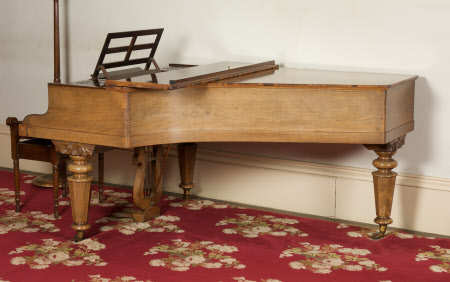
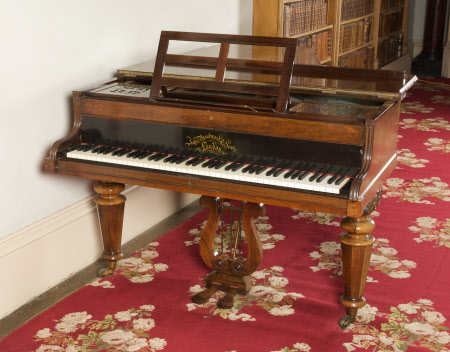
Piano `Broadwood & Sons London`. Veneered in rosewood. The three leg blocks are decorated with acanthus carving. Lyre with brass backstay and two wooden pedals. Ebonised inner face to key cover. Music desk with fret-cut, sliding, candle stands. Keyboard: Natural covers of ivory, sharps of ebony. Compass CC – a 4; width of keyboard 1124; standard measure 490; length of natural heads 46. Action: English Grand action. Over-dampers to b2 inclusive. Pedals: Two, left, due corde shift, right, dampers.
Provenance
Purchased with the family collection of Abbey contents in situ from Mrs Petronella Burnett-Brown December 2009. Information from Dr Alastair Laurence of John Broadwood and Sons Ltd, summarised: No.361 is described in the Broadwood Books as a model number 8 cottage grand pianoforte in rosewood c to a screw pin piece, finished 5th March 1870. (The ‘screw pin’ system had been patented in 1862: the tuning pins have a machine thread and pass through a metal plate on top of the oak wrestplank. The Caution to the Tuner label on the soundboard describes the special care required when replacing a broken string with this system.) Angold, Darling, Dove, and Johnson were workmen involved in the construction; Angold appears to have been a case-maker, Dove the action-finisher and Darling the ‘marker –off’ The piano was despatched, almost eight months after completion, on 2nd November 1870 to the Reverend Edmund Bucknall Estcourt, Rector of Eckington, near Chesterfield, Derbyshire from 1848*. Delivery was via the Midland Railway from St Pancras to Eckington Station in a wooden packing case (additional charge £2/10s). *Crockford’s Clerical Directory 1893 The six foot ‘cottage’ grands were manufactured between 1862 and 1890. 2,185 were produced. (The later models had a larger compass than the Lacock instrument, with a full seven octaves AAA – a 4, and a curved tail instead of the square ‘chisel’ tail) Note I do not know how the piano comes to be at Lacock but the first owner, Edmund Hilary Bucknall-Estcourt, 1803-1894, does provide a link to Fox Talbot: in the online archive of Fox Talbot’s correspondence there are thirty letters, dating from c.1828 to 1865, from Edmund’s older brother, Thomas Henry Sutton Sotheran-Estcourt, 1801-1876. (Two of them allude briefly to the photographic process) http://foxtalbot.dmu.ac.uk/letters/transcriptName. php?bcode=Estc- THS&pageNumber=0&pageTotal=30&referringP age=0 See also: H. M. Stephens, ‘Estcourt, Thomas Henry Sutton Sotheron (1801–1876)’, rev. H. C. G. Matthew, Oxford Dictionary of National Biography, Oxford University Press, 2004 Edmund’s younger brother, Major-General James Bucknall Bucknall-Estcourt, 1802-1855, was Adjutant General under Lord Raglan in the Crimea where he died. (John Sweetman, ‘Estcourt, James Bucknall Bucknall (1802– 1855)’, Oxford Dictionary of National Biography, Oxford University Press, 2004)
Marks and inscriptions
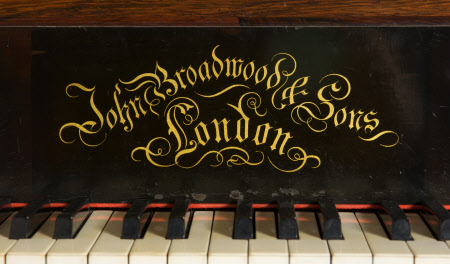
Several inscriptions on the instrument: Gilt lettering on ebonising: John Broadwood & Sons / London; stamped on wrestplank, action standard, keylever cover and lid batten: 361; in ink on paper label below bass end of wrestplank: J Angold / 361; stamped on wrestplank: H.DARLING ; on hammer beam: G.TRALE ; on keylever cover and action standard: H.DOVE ; on lid batten: J.JOHNSON. Cast into the frame on wrestplank: PATENT Printed label on soundboard: Patent Screw Pin Plate / CAUTION TO THE TUNER / The Pins, being screwed into the metal and wood, must not be struck with the hammer. SHOULD A STRING BREAK - Take the coil off without drawing the Pin, then turn the Pin up 1/8 and 1/16, cut the length of new wire off three inches below the Pin and insert the end in the Drilled Hole. MS label at bass end of wrestplank: Revd Edmond (….) nall (…..). See Provenance.