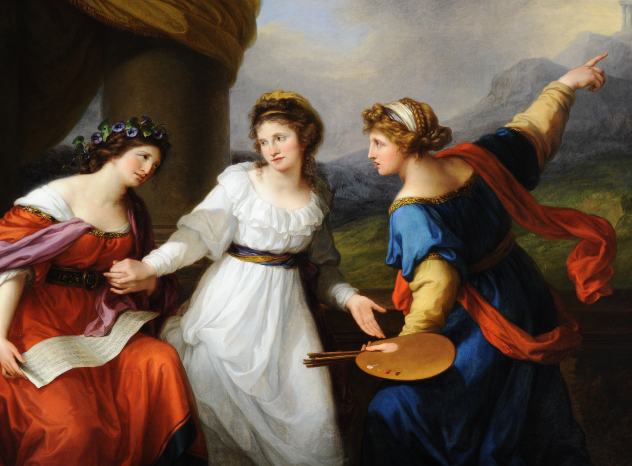
The Four Times of Day: Morning
William Hogarth (London 1697 - London 1764)

Category
Art / Oil paintings
Date
1736
Materials
Oil on canvas
Measurements
737 x 610 mm (29 x 24 in)
Place of origin
London
Order this imageCollection
Upton House, Warwickshire
NT 446680
Caption
This picture is part of a set of four, entitled The Four Times of Day. Night is also at Upton House, but Noon and Evening belong to the Grimsthorpe and Drummond Castle Trustees. The pictures were intended as the models for engravings. The chief protagonist in this picture is a spinster, dressed in finery, on her way to church. She appears little affected by the wintry air, although her foot-boy, who carries her hymnal, has a reddened nose from the cold. She is transfixed by a cavorting couple, completely unaware of the begging woman at her feet. The scene is set in the Piazza of Covent Garden - the once-fashionable square. However, the coffee houses, taverns and brothels were dragging down the reputation of the area. In the right background, Dr Miller is seen setting up his stand for the sale of pills supposed to cure the venereal diseases caught in such places.
Summary
Oil painting on canvas, The Four Times of Day: Morning, by William Hogarth (London 1697 - London 1764), 1736. A scene in Covent Garden piazza early on a winter's morning. In a group at the right outside Tom King's Coffee House two young men are making love to two market girls, and two elderly women are crouched over a fire; one of these solicits alms from a lady, centre, on her way to St. Paul's Church accompanied by her footboy carrying a prayer book. The clock shows 7 a.m. and the Latin inscription underneath reads 'Sic Transit Gloria Mundi', reminding us that none of this world's glories is permanent. In the background is a crowd of figures, some of whom are assembled round a quack on whose board is inscribed D. Miller's Famous (in the engraving this name is altered to Dr Rock (1690 - 1777), the quack doctor previously seen in A Harlot's Progress.
Full description
Hogarth painted The Four Times of Day only about two years before The Hervey Conservation-Piece (Noon and Evening belong to the Grimsthorpe & Drummond Castle Trustees). The same amused - but, in this case, more overtly satirical - observation of human foibles, and the same sheer delight in manipulating the brush, obtain in each. But whereas many of the symbolic allusions of The Hervey Conversation-Piece now escape us, the moral and topical ones of The Four Times of Day are mostly more obvious, or have been spelled out for us by eighteenth-century commentators; yet the pictures, because they were intended to be the models for, and sold on the back of the publication of, engravings after them, tend towards an accumulation of detail that makes them in some ways easier to read in the form of prints, than as paintings. Of the four, only Morning really escapes this charge, having a unity of action and of composition that makes it possible to appreciate the picture even without any particular knowledge of its individual allusions. That may also be because Morning is the picture most securely anchored in the tradition of showing the Four Times of Day through the diurnal round of ladies (see the set of engravings by Nicolas Arnoult) or gentlemen (see the set by Gabriel Le Brun) of fashion. For it is this French tradition, and not the earlier Netherlandish one of allegories and personifications, over which so much ink has been spilled, but which was dead by the end of the 17th century, that was Hogarth's immediate source of inspiration; and to whose reinvigoration in France, in the hands of Lancret, Boucher, and Jeaurat, his own prints may themselves thereafter have contributed. The traditional way of showing Morning was by La Toilette , and it is for that reason that Hogarth has chosen as his chief protagonist a spinster, "the exhausted representative of involuntary female celibacy" , bound for church, but dressed up to the nines; significantly, it is her freezing foot-boy who carries her prayer-book, whilst she - somehow impervious to the cold in all but her nose, despite her half-bared bosom and lack of mantle - manipulates a fan. To the left of her, a woman warms her hands at a fire, whilst two couples are more naturally kindled by animal heat; the attention of the old maid is riveted by one of these, so that she entirely ignores the woman begging for alms beneath her. She is so vividly drawn as to seem a portrait, but the story related by John Nichols that she was a friend or relative of Hogarth's, and that he was struck out of her will in consequence of the portrayal, was probably inspired by the picture - as Henry Fielding was, when he avoided describing the appearance of Bridget Allworthy in Tom Jones (1749), by saying: "that is done already by a more able Master, Mr. Hogarth himself, to whom she sat many Years ago, and hath been lately exhibited by that Gentleman in his print of a Winter's Morning, of which she was no improper Emblem" . The scene is set in the Piazza of Covent Garden, a once-fashionable square that had also been, "inhabited by Painters. 'A credit to live there'", only a decade before . Hogarth had himself been an inhabitant, at first in lodgings, and then in the house of his father-in-law, Sir James Thornhill, just before and after his marriage in 1730; but in 1733 he had moved to Leicester Fields, soon to be made even more fashionable by George II as Prince of Wales taking Leicester House. Bagnios (often brothels), taverns, and coffee-houses - all of which had long been in and around Covent Garden - were inexorably dragging the character of the area down (whilst St. Paul's itself was said to be a place for finding partners or making assignations). Hogarth actually inscribed the name of one of these (differently located) taverns, ironically, as Tom King's Coffee House, over its door (through which roisterers with drawn swords and canes can be seen in the print, but not - or no longer - in the painting), and it was said that it was the notoriety that the print thus advertised that finally prompted the authorities to arrest the old Etonian Tom's widow, Moll King, for keeping a disorderly house, to fine her, and to make her pull the shack down . In the background of the painting Dr Miller (his name was changed to Dr Rock in the engraving) is seen setting up his stand for the sale of the pills supposed to cure the venereal disorders engendered in such places. Night is a more confused scene, interestingly - in view of the suggested similar content of The Hervey Conversation-Piece - replete with Masonic - but also crypto-Jacobite - allusions. On one side is the Rummer tavern, and on the other (somewhat misplaced) is the Cardigan's Head (both of which served as early Masonic lodges) . In front of the former, a Mason in apron and full regalia, Col. Thomas De Veil , is so drunk and knocked about that he has to be supported home by a Tyler colleague. His drunkenness is particularly significant, in view of the fact that De Veil, though a known tippler, was so severe an enforcer of the Hanoverian acts against the illegal sale of spirituous liquors that there were riots against him and his informers, which were suppressed by recourse to the equally Hanoverian Riot Act (in view of Hogarth's own opposition to spirits, as manifested by his later engravings of Beer Street and Gin Lane, and his own membership of a masonic lodge, it was clearly the hypocrisy of the magistrate, rather than his severity, that he was attacking). The anti-Hanoverian and crypto-Jacobite implications of the picture are reinforced by the fact that the scene is shown as taking place on Oak-Apple Day (May 29th), when, to commemorate Charles II's escape from pursuit after the Battle of Worcester (Sept. 3rd) in the Boscobel Oak, oak branches were displayed, bonfires were lit, fireworks let off, and candles put in windows; and by the statue of Charles I, King and Martyr, visible at Charing Cross, at the end of the street. A general impression of topsi-turviness and of a world in disorder (there is perhaps some significance in its being full moon, when lunatics were supposed to be most off their wits) - in utter contrast to the calm centre of Morning - is conveyed by the collapsing Salisbury Flying Coach, by a man being shaved in the middle of the night (his apron implicitly mocking those of the Freemasons), by a link-boy blowing his torch into flame, rather than extinguishing it, and by a chamber-pot being emptied out of a window, and ricocheting onto the drunken De Veil (who also wears oak-leaves in his hat, even though a supporter of the supplanting dynasty). Under cover of darkness, a distant cart performs a moonlight flit, and a publican waters his beer. Hogarth advertised his engravings of the Four Times of Day, along with that of Strolling Actresses Dressing in a Barn (the painting has been destroyed by fire) in May 1737, and called for subscriptions. The engravings were ready for delivery to subscribers on 1 May 1738. The paintings having been made expressly to be engraved, there was - in the absence of any sort of market for contemporary art, and only a rigged market, at whose machinations Hogarth was by turns contemptuous and outraged, in Old Masters - no very obvious means of selling them - at least at the value that the artist put on them. On 25 January 1744/45 he therefore advertised a novel auction of his own sets of "comic-history-paintings": The Harlot's Progress, The Rake's Progress, The Four Times of Day, and Strolling Actresses in a Barn. A month later he issued an engraving, The Battle of the Pictures, as an admission-ticket to his house for the sale, to such as had announced themselves in advance by entering their preliminary bids in a book at least a day beforehand. The 'battle' was between a whole covey of Old Master paintings and some of Hogarth's: the hypocritical dévote of Morning is shown speared by a corner of the canvas of a genuinly penitential St Francis (just as a Penitent Magdalen gashes the third picture of the - as yet far from repentant - Harlot's Progress) . Hogarth's original intention was to sell the sets as such, but he subsequently changed his mind, to allow the possibility of their being bought: "Singly (each Picture being an entire Subject of itself) or in Sets". In the event, the two major sets, the Rake's and the Harlot's Progress, went as such, to the future Alderman Beckford. The Times of Day were, however, split up into two pairs: Morning and Night going to the retired merchant, Sir William Heathcote, 1st Bt., for 46 guineas, and Noon and Evening to the 3rd Duke of Ancaster for 75 guineas (Horace Walpole bought an extra lot, the little Sarah Malcolm, for 5 guineas). The whole sale, of some twenty pictures, realised around £450, which Vertue - but not, apparently, Hogarth - thought a surprisingly successful result for such "impudence" ("no painters nor Artists to be admitted to his sale" , he noted, as a mark of Hogarth's pretensions) - certainly a great contrast with the fiasco of the attempted sale of Marriage à-la-Mode by similar means five years later. But then, not only were these "comic-history-paintings" sui generis, and examples of Hogarth at the top of his form, they were still highly topical. They may no longer be so for us, but we can still relish them; above all the figures of the vain old maid and her starveling foot-boy - which, tellingly, Hogarth used on their own, to stand for the whole painting, in The Battle of the Pictures - as marvels of both paint and psychology. (adapted from author's version/pre-publication, Alastair Laing, In Trust for the Nation, exh. cat., 1995)
Provenance
The artist's sale, his house, Leicester Fileds, 28 Feb 1744/5, sold, for 26 gns (Night) and 20 gns (Morning), to Sir William Heathcote, 1st Bt; thence by descent (included in an illustrated MS inventory of the pictures of Hursley Park, Hants, of 1843, in Dept. of Special Collections, Getty Center, Malibu) as nos. 11 and 12 in the South Drawing Room, with a note that they featured in a Catalogue of Pictures in the Heathcote house in St James's Square of 1748); Heathcote Heirlooms sale, Christie's, 27 May 1938, lot 29; bought by Sir Alec Martin on behalf of Viscount Bearsted for 2.400 gns (outbidding the Earl of Lancaster, who had commendably wished to re-unite the set); given with Upton House to the National Trust by Walter Samuel, 2nd Viscount Bearsted (1882 – 1948), in 1948, shortly before his death
Credit line
Upton House, The Bearsted Collection (National Trust)
Makers and roles
William Hogarth (London 1697 - London 1764), artist
Exhibition history
Hogarth: Place and Progress, Sir John Soane's Museum, London, 2019 - 2020 Hogarth, Musée du Louvre, Paris, 2006 - 2007, no.67 Hogarth, Tate Britain, London, 2006 - 2007, no.67 Hogarth, CaixaForum, Madrid, 2006 - 2007, no.67 In Trust for the Nation, National Gallery, London, 1995 - 1996, no.19a
References
Nichols 1781, 1782, 1785 John Nichols, Biographical Anecdotes of William Hogarth and a Catalogue of his Works, 1781, rev. 1782, rev. 1785, pp.99—100; 1782, pp.208—11; 1785, pp.248—51 Felton 1785 W. Felton, An Explanation of several of Mr. Hogarth's Prints, 1785, pp.27—33 Nichols and Steevens 1808 J. Nichols and G. Steevens, The Genuine Works of William Hogarth, London, 1808 - 17 (3 vols.), vol I, pp. 102—3 & 116—118, vol.II (1810), pp.147—50 & vol.III (1817), p.174 Shesgreen 1983 Sean Shesgreen, Hogarth and the Times of Day Tradition, Ithaca, 1983 Paulson 1965, 1970, 1989 Ronald Paulson, Hogarth's Graphic Works, New Haven, 1965, 2 vols; rev. 1970, rev. 1989, i, pp. 178-9, 181-2; 1970, i. pp. 178-9, 181-2 Paulson 1991-3; Ronald Paulson, Hogarth, New Brunswick, 3 vols, 1991-1993, ii, pp. 127 - 51, esp. pp. 149-50, pp. 411-14 nn. 1-27