The Borghese Gladiator
Category
Art / Sculpture
Date
circa 1775 - circa 1899
Materials
Bronze on black marble base
Measurements
512 x 500 x 460 mm
Order this imageCollection
Belton House, Lincolnshire
NT 435366
Summary
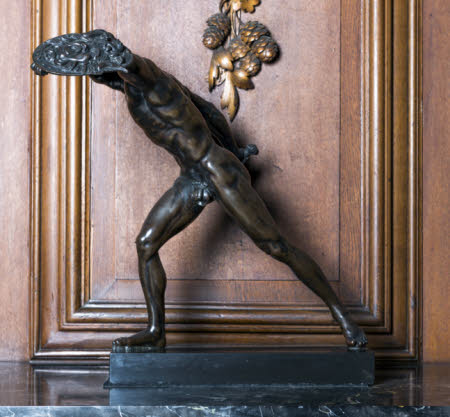
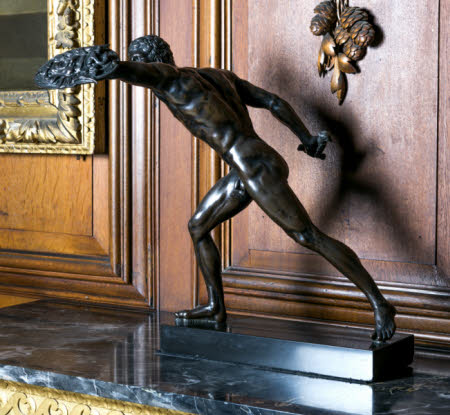
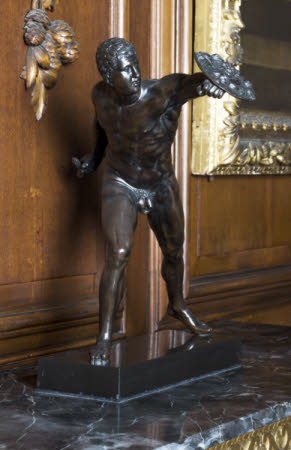
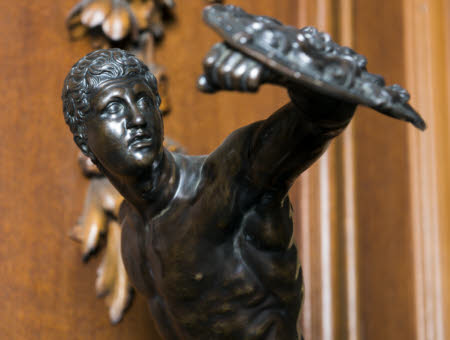
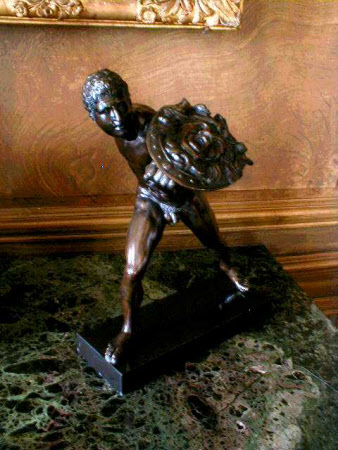
Bronze on black marble base, The Borghese Gladiator, French or Italian, late 18th or 19th century. A bronze statuette of a warrior in combat, mounted on a rectangular black marble base. After The Borghese Gladiator, a Hellenistic sculpture formerly in the Borghese collection and later acquired for The Louvre (MR 224). The figure lunges forward, with his left arm thrust in the air, raising a round shield embossed with the head of Medusa. His right arm, sword in hand, thrusts backwards. The blade of the sword is missing but its handle is rendered in the shape of an eagle’s head. The head, torso, arms and legs have been sleeve joined.
Full description
Copies of The Borghese Gladiator proliferated within twenty years of the Ephesus marble being discovered at Nettuno in 1611. Charles I acquired a mould of it and commissioned Hubert le Seur to cast a bronze in 1629-30. Placed in the Privy Garden at St James’ Palace, le Seur’s bronze raised the profile of the sculpture and soon after casts began to appear in country houses across the country. A plaster cast was also sent by Velázquez to Philip IV of Spain. Bronze reductions of The Borghese Gladiator holding a Medusa shield are found in casts after Guillaume Berthelot (c.1580-1648) and Roger Schabol (fl.1680s–after 1714); see Tomasso Brothers 2009, pp.52-3, Sotheby’s, European Sculpture and Works of Art (London, 8 July 2005, lot no.59); Leithe-Jasper and Wengraf 2004, no. 35, fig. 1, p. 298. Unlike these fine 17th-century examples, this later cast at Belton House shows the Medusa in high relief. The gorgon is probably derived from Mask of Medusa by Henri Perlan (1597-1656). A bronze almost identical to the Belton cast but with a gilt shield is in the catalogue of Vieban Fine Arts (no.1846). Alice Rylance-Watson October 2018
Provenance
Purchased with a grant from the National Heritage Memorial Fund (NHMF) from Edward John Peregrine Cust, 7th Baron Brownlow, C. St J. (b.1936) in 1984.
References
Tomasso Brothers 2009: Tomasso Brothers Fine Art, Scultura II, exh.cat. venue: Williams Moretti & Irving Gallery, New York, London 2009, pp.52-3 Leithe-Jasper and Wengraf 2004: Manfred Leithe-Jasper and Patricia Wengraf, European Bronzes from the Quentin Collection (Frick Collection), New York 2004, p. 298, no. 35 Bresc-Bautier, Scherf and Draper 2009: Geneviève Bresc-Bautier, Guilhem Scherf and James David Draper (eds.), Cast in Bronze: French Sculpture from Renaissance to Revolution, exh. cat., Metropolitan Museum of Art, New York, Paris 2009, pp. 62, 172-75 Haskell and Penny 1981: Francis Haskell and Nicholas Penny, Taste and the Antique, The Lure of Classical Sculpture 1500 - 1900, New Haven and London, 1981, pp. 221-4