You searched for parts within a set, National Trust Inventory Number: “30183

Show me:
and
Clear all filters

  • Explore
  • Explore
  • Explore
  • Explore
  • Explore
  • Explore
  • Explore
  • Explore
  • Explore
  • Explore
  • Explore
  • Explore
  • Explore
  • Explore
  • Explore
  • Explore
  • Explore
  • Explore
  • Explore
  • Explore
  • Explore
  • Explore
  • Explore
  • Explore
  • Explore
  • Explore
  • Explore
  • Explore
  • Explore
  • Explore
  • Explore
  • Explore
  • Explore
  • Explore
  • Explore
  • Explore
  • Explore
  • Explore
  • Explore
  • Explore
  • Explore
  • Explore
  • Explore
  • Explore
  • Explore
  • Explore
  • Explore
  • Explore
  • Explore
  • Explore
  • Explore
  • Explore
  • Explore
  • Explore
  • Explore
  • Explore
  • Explore
  • Explore
  • Explore
  • Explore
  • Explore
  • Explore
  • Explore
  • Explore
  • Explore
  • Explore
  • Explore
  • Explore
  • Explore
  • Explore
  • Explore
  • Explore
  • Explore
  • Explore
  • Explore
  • Explore
  • Explore
  • Explore
  • Explore
  • Explore
  • Explore
  • Explore
  • Explore
  • Explore
  • Explore
  • Explore
  • Explore
  • Explore
  • Explore
  • Explore
  • Explore
  • Explore
  • Explore
  • Explore
  • Explore
  • Explore
  • Explore
  • Explore
  • Explore
  • Explore
  • Explore
  • Explore
  • Explore
  • Explore
  • Explore
  • Explore
  • Explore
  • Explore
  • Explore
  • Explore
  • Explore
  • Explore
  • Explore
  • Explore
  • Explore
  • Explore
  • Explore
  • Explore
  • Explore
  • Explore
  • Explore
  • Explore
  • Explore
  • Explore
  • Explore
  • Explore
  • Explore
  • Explore
  • Explore
  • Explore
  • Explore
  • Explore
  • Explore
  • Explore
  • Explore
  • Explore
  • Explore
  • Explore
  • Explore
  • Explore
  • Explore
  • Explore
  • Explore
  • Explore
  • Explore
  • Explore
  • Explore
  • Explore
  • Explore
  • Explore
  • Explore
  • Explore
  • Explore
  • Explore
  • Explore
  • Explore
  • Explore
  • Explore
  • Explore
  • Explore
  • Explore
  • Explore
  • Explore
  • Explore
  • Explore
  • Explore
  • Explore
  • Explore
  • Explore
  • Explore
  • Explore
  • Explore
  • Explore
  • 2 items Explore
  • Explore
  • Explore
  • Explore
  • Explore
  • Explore
  • Explore
  • Explore
  • Explore
  • Explore
  • Explore
  • Explore
  • Explore
  • Explore
  • Explore

Select a time period

Or choose a specific year

Clear all filters

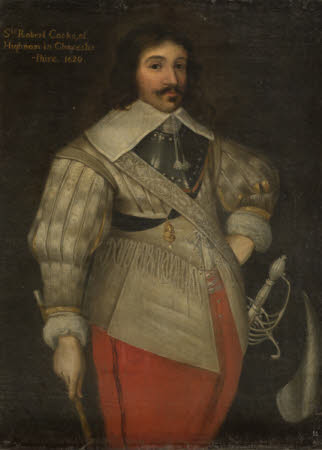
Sir Robert Coke (1586-1653)

British (English) School
Category

Art / Oil paintings

Date

1620 - 1629

Materials

Oil on canvas

Measurements

1048 x 768 mm (41 1/4 x 30 1/4 in)

Order this image

Collection

Oxburgh Hall, Norfolk

NT 1210347

Summary

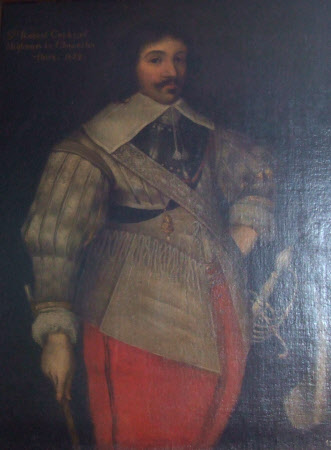
Oil painting on canvas, Sir Robert Coke (1586 - 1653) by British (English) School, inscribed with name of the sitter and date, in coarse yellow letters, top left: Sir Robert Cooke of/ Highnam in Gloucester/shire, 1629. A three-quarter-length portrait, standing, turned slightly to the right, gazing at the spectator, his left hand on hip and right hand holding a silver-topped cane. He has long, dark hair and a small beard and moustache. His long, silver doublet is laced and has full slashed sleeves, winged and with white ruffles showing at the wrist. He has scarlet breeches and a breastplate, over which lies a wide, white collar. He wears from a back sash a memorial medal composed of a gilt-bronze pendant with the head of Gustavus Adolphus above a skull and cross bones. The inscription identifies the sitter as Sir Robert Cooke of Highnam, Gloucestershire. That Sir Robert Cooke (c. 1598 – 1643) was an English politician who sat in the House of Commons between 1640 and 1643. He served in the Parliamentarian army in the English Civil War. The sitter may is more likely to be Sir Robert Coke (1587–1653), the son of Sir Edward Coke (1552-1634), Lord Chief Justice, and Bridget Paston (1562 - 1598), daughter of Sir John Paston and Anne Moulton. Sir Robert Coke married Theophila, daughter of Lord Berkeley. He was knighted in 1607 and sat in Parliament for Coventry (1614) and Fowey (1624), where he served on several committees and spoke in defence of parliamentary scrutiny of officials. A noted book collector, he struggled with heavy debts despite inheriting estates in Suffolk and Surrey. During the Civil War he supported the Royalist cause, was imprisoned in the Tower, and had his estates sequestered. He died while serving as High Sheriff of Suffolk under the Commonwealth and was buried at Epsom. His monument is at St Martin of Tours, Epsom.

Provenance

Part of the Bedingfeld collection; given to the National Trust by Sybil Lyne-Stephens, Lady Paston-Bedingfeld (1883 – 1985), 1961

Marks and inscriptions

Recto: Sir Robert Cooke of Highnam in Gloucestershire, 1629 Recto: White catalogue number '82'l.r.

Makers and roles

British (English) School, artist

View more details